


Page 677 - (DK Eyewitness) Travel Guide - India
P. 677
ANDHR A PR ADESH AND TELANGANA 675
9 Srikakulam
settlement in the early 17th the state tourism department
century. Bimlipatam, as it was as a major attraction for visitors. District
then known (locally referred to Some smaller stalagmites are 108 km (67 miles) NE from
as Bhimli), was the site of Maratha worshipped as lingas, with Visakhapatnam to Srikakulam. @
attacks and Anglo-Dutch wars Nandi bulls placed in front of
throughout the 17th and 18th them. The local people believe The headquarters of Andhra
centuries. Its Dutch legacy can that the water trickling from Pradesh’s northernmost district,
be seen in some of the old the roof of the caves is from Srikakulam is located on the
colonnaded houses, the ruined a mountain spring, which banks of the Swarnamukhi river.
fort, and the Dutch cemetery, is the source of the On the outskirts
which has unusual, obelisk- Gosthani river. of the town, at
shaped tombstones. Arasavalli, is a sun
Environs temple, ingeniously
About 22 km constructed at such
(14 miles) northeast an angle that the
of Borra is the Araku sun’s rays fall directly
Valley, home on the deity’s
of several tribal feet twice a year.
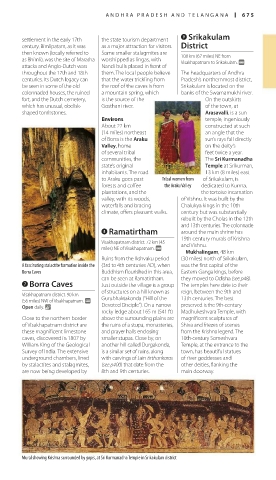
communities, the The Sri Kurmanadha
state’s original Temple at Srikurman,
inhabitants. The road 13 km (8 miles) east
to Araku goes past Tribal women from of Srikakulam, is
forests and coffee the Araku Valley dedicated to Kurma,
plantations, and the the tortoise incarnation
valley, with its woods, of Vishnu. It was built by the
waterfalls and bracing Chalukya kings in the 10th
climate, offers pleasant walks. century but was substantially
rebuilt by the Cholas in the 12th
and 13th centuries. The colonnade
8 Ramatirtham around the main shrine has
19th century murals of Krishna
Visakhapatnam district. 72 km (45
miles) NE of Visakhapatnam. @ and Vishnu.
Mukhalingam, 48 km
Ruins from the Ikshvaku period (30 miles) north of Srikakulam,
A fascinating stalactite formation inside the (3rd to 4th centuries AD), when was the first capital of the
Borra Caves Buddhism flou rished in this area, Eastern Ganga kings, before
can be seen at Ramatirtham. they moved to Odisha (see p48).
7 Borra Caves Just outside the village is a group The temples here date to their
of structures on a hill known as reign, between the 9th and
Visakhapatnam district. 90 km
(56 miles) NW of Visakhapatnam. @ Gurubhaktakonda (“Hill of the 13th centuries. The best
Open daily. & Devoted Disciple”). On a narrow preserved is the 9th-century
rocky ledge about 165 m (541 ft) Madhukeshvara Temple, with
Close to the northern border above the surrounding plains are magnificent sculptures of
of Visakhapatnam district are the ruins of a stupa, monasteries, Shiva and friezes of scenes
these magnificent limestone and prayer halls enclosing from the Krishna legend. The
caves, discovered in 1807 by smaller stupas. Close by, on 10th-century Someshvara
William King of the Geological another hill called Durgakonda, Temple, at the entrance to the
Survey of India. The extensive is a similar set of ruins, along town, has beautiful statues
underground chambers, lined with carvings of Jain tirthankaras of river goddesses and
by stalactites and stalagmites, (see p400) that date from the other deities, flanking the
are now being developed by 8th and 9th centuries. main doorway.
Mural showing Krishna surrounded by gopis, at Sri Kurmanadha Temple in Srikakulam district
674-675_EW_India.indd 675 26/04/17 11:50 am

