


Page 679 - (DK Eyewitness) Travel Guide - India
P. 679
ANDHR A PR ADESH AND TELANGANA 677
Trade Textiles: Tree of Life
Between the 17th and 18th centuries, the Coromandel Coast, with Machilipatnam
as its trade centre and port, was one of the main producers and exporters of cotton
textiles to Western Europe. At first just items of barter, they soon became fashionable
in Europe, increasing the demand for the region’s dye-painted cotton kalamkari
(see p684) fabric, known in Europe as chintz. Special designs were commissioned,
among them the Tree of Life, which absorbed techniques and aesthetics from
India, Persia, China and Europe. Valued for their richness of colour and design,
they were widely used as hangings and spreads in European homes.
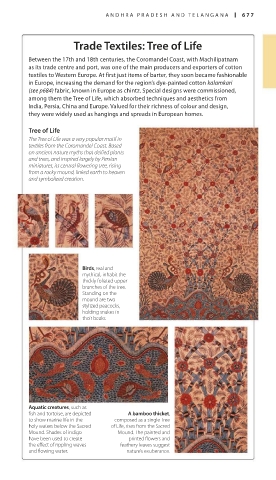
Tree of Life
The Tree of Life was a very popular motif in
textiles from the Coromandel Coast. Based
on ancient nature myths that deified plants
and trees, and inspired largely by Persian
miniatures, its central flowering tree, rising
from a rocky mound, linked earth to heaven
and symbolized creation.
Birds, real and
mythical, inhabit the
thickly foliated upper
branches of the tree.
Standing on the
mound are two
stylized peacocks,
holding snakes in
their beaks.
Aquatic creatures, such as
fish and tortoise, are depicted A bamboo thicket,
to show marine life in the composed as a single Tree
holy waters below the Sacred of Life, rises from the Sacred
Mound. Shades of indigo Mound. The painted and
have been used to create printed flowers and
the effect of rippling waves feathery leaves suggest
and flowing water. nature’s exuberance.
676-677_EW_India.indd 677 26/04/17 11:50 am

