


Page 168 - (DK Eyewitness) Travel Guide: Japan
P. 168
166 JAP AN REGION B Y REGION
7 Pontocho Alley
Pontocho Alley
£ Kawaramachi stn, Hankyu Kyoto
line. @ 5, 17, 205 to Shijo-
Kawaramachi.
This charming alleyway is best
appreciated after dusk, when
it is reminiscent of an ukiyo-e
print (see p89). For merly a
sandbar, the stretch of land
began to be developed in
1670. The area flourished as an
entertainment district and was
licensed as a geisha quarter,
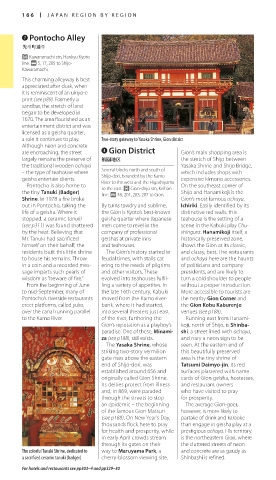
a role it continues to play. Two-story gateway to Yasaka Shrine, Gion district
Although neon and concrete
are encroaching, the street 8 Gion District Gion’s main shopping area is
largely remains the preserve of Gion District
the stretch of Shijo between
the traditional wooden ochaya Yasaka Shrine and Shijo Bridge,
– the type of teahouse where Several blocks north and south of which includes shops with
geisha entertain clients. Shijo-dori, bounded by the Kamo ex pensive kimono accessories.
River to the west and the Higashiyama
Pontocho is also home to to the east. £ Gion-shijo stn, Keihan On the southeast corner of
the tiny Tanuki (Badger) line. @ 46, 201, 203, 207 to Gion. Shijo and Hanamikoji is the
Shrine. In 1978 a fire broke Gion’s most famous ochaya,
out in Pontocho, taking the By turns tawdry and sublime, Ichiriki. Easily identified by its
life of a geisha. Where it the Gion is Kyoto’s best-known distinctive red walls, this
stopped, a ceramic tanuki geisha quarter where Japanese teahouse is the setting of a
(see p311) was found shat tered men come to revel in the scene in the Kabuki play Chu
by the heat. Believing that company of professional shingura. Hanamikoji itself, a
Mr. Tanuki had sacrificed geishas at private inns historically preserved zone,
himself on their behalf, the and teahouses. shows the Gion at its classic,
residents built this little shrine The Gion’s history started in and classy, best. The restau rants
to house his remains. Throw feudal times, with stalls cat- and ochaya here are the haunts
in a coin and a recorded mes- ering to the needs of pilgrims of politicians and com pany
sage imparts such pearls of and other visitors. These presidents, and are likely to
wisdom as “beware of fire.” evolved into teahouses fulfil- turn a cold shoulder to people
From the beginning of June ling a variety of appetites. In without a proper intro duction.
to mid-September, many of the late 16th century, Kabuki More accessible to tourists are
Pontocho’s riverside restau rants moved from the Kamo river- the nearby Gion Corner and
erect platforms, called yuka, bank, where it had started, the Gion Kobu Kaburenjo
over the canal running parallel into several theaters just east venues (see p188).
to the Kamo River. of the river, further ing the Running east from Hanami-
Gion’s reputation as a playboy’s koji, north of Shijo, is Shinba-
paradise. One of these, Minami- shi, a street lined with ochaya,
za (see p188), still exists. and nary a neon sign to be
The Yasaka Shrine, whose seen. At the eastern end of
striking two-story vermilion this beautifully preserved
gate rises above the eastern area is the tiny shrine of
end of Shijo-dori, was Tatsumi Daimyo-jin, its red
established around 656 and surfaces plastered with name
originally called Gion Shrine. cards of Gion geisha, hostesses,
Its deities protect from ill ness and restaurant owners
and, in 869, were paraded who have visited to pray
through the streets to stop for prosperity.
an epidem ic – the beginning The average Gion-goer,
of the famous Gion Matsuri however, is more likely to
(see p188). On New Year’s Day, partake of drink and karaoke
thousands flock here to pray than engage in geisha play at a
for health and prosperity, while prestigious ochaya. His ter ritory
in early April crowds stream is the northeastern Gion, where
through its gates on their the cluttered streets of neon
The colorful Tanuki Shrine, dedicated to way to Maruyama Park, a and concrete are as gaudy as
a sacrificed ceramic tanuki (badger) cherry-blossom viewing site. Shinbashi is refined.
For hotels and restaurants see pp303–4 and pp329–30
166-167_EW_Japan.indd 166 08/08/16 3:07 pm
Eyewitness Travel LAYERS PRINTED:
Catalogue template “UK” LAYER
(Source v2.6)
Date 12th July 2013
Size 125mm x 217mm

