


Page 175 - (DK Eyewitness) Travel Guide: Japan
P. 175
K Y O T O CIT Y 173
The Tea Ceremony
Valued for its medicinal qualities, tea was imported from China in the 8th century.
The nobility took to drinking it at lavish parties, and Murata Shuko (1422–1502) later
developed the custom’s spiritual aspects, which appealed to the samurai. The point of
the ritual (chaji), in which a light meal and whisked powdered tea (matcha) are served
by a host to a few in vited guests, is summed up by the samurai notion “one lifetime, one
meeting” (ichigo, ichie). In other words, this is a unique moment to be treasured. In Kyoto,
where the tea ceremony was developed, special rituals are put on for tour ists (see p189),
with commentary about the complex etiquette and Zen ideals. Visitors can also enjoy
matcha and a sweet (wagashi) without the ritual at many tem ples and specialty teashops.
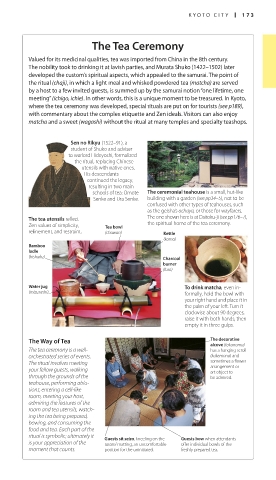
Sen no Rikyu (1522–91), a
student of Shuko and adviser
to warlord Hideyoshi, formal ized
the ritual, replacing Chinese
utensils with native ones.
His de scendants
continued the legacy,
resulting in two main
schools of tea: Omote The ceremonial teahouse is a small, hut-like
Senke and Ura Senke. building with a garden (see pp34–5), not to be
confused with other types of teahouses, such
as the geisha’s ochaya, or those for wayfarers.
The tea utensils reflect The one shown here is at Daitoku-ji (see pp176–7),
Zen values of simplicity, Tea bowl the spiritual home of the tea ceremony.
refinement, and restraint. (chawan) Kettle
(kama)
Bamboo
ladle
(hishaku) Charcoal
burner
(furo)
Water jug To drink matcha, even in -
(mizusashi) formally, hold the bowl with
your right hand and place it in
the palm of your left. Turn it
clockwise about 90 degrees,
raise it with both hands, then
empty it in three gulps.
The Way of Tea The decorative
alcove (tokonoma)
The tea ceremony is a well- has a hanging scroll
orchestrated series of events. (kakemono) and
The ritual involves meeting sometimes a flower
arrangement or
your fellow guests, walking art object to
through the grounds of the be admired.
teahouse, performing ablu-
tions, entering a cell-like
room, meeting your host,
admiring the features of the
room and tea utensils, watch-
ing the tea being prepared,
bowing, and consuming the
food and tea. Each part of the
ritual is symbolic; ulti mately it Guests sit seiza, kneeling on the Guests bow when attendants
is your appreciation of the tatami matting, an uncomfortable offer individual bowls of the
moment that counts. position for the uninitiated. freshly prepared tea.
172-173_EW_Japan.indd 173 08/08/16 2:54 pm

