


Page 48 - (DK Eyewitness) Travel Guide - Scotland
P. 48
46 INTRODUCING SC O TLAND THE HIST OR Y OF SC O TLAND 47
Christianity and Unification David I tried to impose this system in the man, lost. William Wallace rose and led a
Christianity remained in an isolated pocket north, but the region remained out of his revolt that rekindled hope until his capture
centred around Whithorn on the Solway con trol and, indeed, had its own “kings” – and execution six years later. His cause was
Coast, until the great warrior-missionary, the Lords of the Isles. In the Highlands taken up by Robert the Bruce who,
St Columba, arrived from Ireland and a different social structure based against all odds, won support and
established his monastery on the small on kinship – that of families, or clans raised an army that changed the
Hebridean island of Iona in 563. Fired by – had evolved. The chief was a course of history by winning a
his zeal, the new reli gion spread rapidly. patriarch who held land, not decisive victory over the English at
By 800, Iona had achieved widespread privately, but on behalf of his the Battle of Bannockburn, near
influence, and Columban missionaries people. It was an inheritable Stirling, on 23 June 1314.
worked all over Europe. The Celtic Church position, but the chief remained Confronted by the largest English
devel oped along monastic lines and accoun table to the clan and could The lion of Scotland, army to cross the border, the Scots
remained predominantly reclusive by be removed by common consent, dating from 1222 were out number ed three to one,
nature, dedicating itself to worship and unlike the feudal land lords whose and their arms were inferior. Yet
scholarship. Among its surviving works of power was vested through legal title to the Bruce had chosen his ground and his strategy
art is the famous Book of Kells. This lavish, land. This subtle difference was mirrored on carefully and, despite the enemy’s skilful
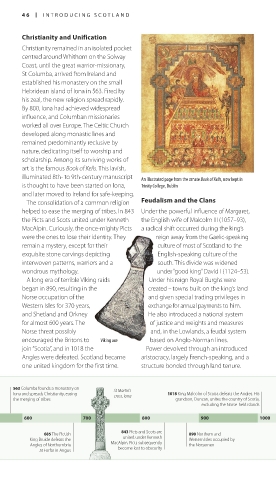
illuminated 8th- to 9th-century manuscript An illustrated page from the ornate Book of Kells, now kept in a national level – in England, the monarch bowmen and heavy cavalry, the Scots
is thought to have been started on Iona, Trinity College, Dublin was the King of England; in Scotland, he gained the vic tory they so badly needed.
and later moved to Ireland for safe-keeping. was known as the King of Scots. Scotland had won back its indepen dence,
The consolidation of a common reli gion Feudalism and the Clans but it was not until 1329 that its sovereign
helped to ease the merging of tribes. In 843 Under the powerful influence of Margaret, The Wars of Independence and the status was recognized and secured by a
the Picts and Scots united under Kenneth the English wife of Malcolm III (1057–93), Battle of Bannockburn Papal bull (six days after Bruce had died).
MacAlpin. Curiously, the once-mighty Picts a radical shift occurred during the king’s In 1222 the lion of Scotland’s coat of arms Even so, the wars with England would
were the ones to lose their identity. They reign away from the Gaelic-speaking first appeared on the great seal of Alexander continue for another 300 years.
remain a mystery, except for their culture of most of Scot land to the II. This was during a relatively
exquisite stone carv ings depicting English-speaking culture of the peaceful interlude among frequent
interwoven patterns, warriors and a south. This divide was widened periods of tur moil when it seemed
wondrous mythology. under “good king” David I (1124–53). that Scotland was in danger of
A long era of terrible Viking raids Under his reign Royal Burghs were breaking apart.
began in 890, resulting in the created – towns built on the king’s land When Alexander III’s infant
Norse occupation of the and given special trading privileges in daughter died in 1290, there was
Western Isles for 370 years, exchange for annual payments to him. no heir to the throne. Edward I of
and Shetland and Orkney He also introduced a national system England installed a puppet king
for almost 600 years. The of justice and weights and measures and, in 1296, led a devastating
Norse threat possibly and, in the Lowlands, a feudal system invasion that carried off the Stone
encouraged the Britons to Viking axe based on Anglo-Norman lines. of Destiny – the Scots’ coronation
join “Scotia”, and in 1018 the Power devolved through an introduced throne – and earned him the title
Angles were defeated. Scotland became aristocracy, largely French-speaking, and a “Hammer of the Scots”. Scotland
one united kingdom for the first time. structure bonded through land tenure. was crushed and, but for one Robert the Bruce in combat at the Battle of Bannockburn (1314)
1124–53 David I
563 Columba founds a monastery on St Martin’s imposes Norman 1296 Edward I takes Stone of 1320 Declaration of Arbroath sent to
Iona and spreads Christianity, easing cross, Iona 1018 King Malcolm of Scotia defeats the Angles. His feudal system. A Destiny from Scone Abbey the Pope – an eloquent appeal for
the merging of tribes grandson, Duncan, unites the country of Scotia, clan system prevails to Westminster recognition of Scottish independence
excluding the Norse-held islands and sovereignty
in Highlands
600 700 800 900 10001000 1100 1200 1300 1400
1263 Western 1328–9 Independence and sovereignty
843 Picts and Scots are 1154 Loss of “southern
685 The Pictish 890 Northern and Isles won back affirmed by Treaty with England and
King Bruide defeats the united under Kenneth Western Isles occupied by counties” to England from Norse Papal bull
Angles of Northumbria MacAlpin. Picts subsequently the Norsemen
at Forfar in Angus become lost to obscurity Edward I 1314 Robert the Bruce defeats 1326 Meeting of first
(1239–1307) the English at Bannockburn Scottish Parliament
046-047_EW_Scotland.indd 46 10/23/17 11:56 AM 046-047_EW_Scotland.indd 47 10/23/17 11:56 AM

