


Page 50 - (DK Eyewitness) Travel Guide - Scotland
P. 50
48 INTRODUCING SC O TLAND THE HIST OR Y OF SC O TLAND 49
The Stuarts Union with England
In 1371 began the long dynasty of the Mary’s son, James VI, had reigned for 36 years
House of Stuart, a family distinguished by when he became heir to the English throne.
intelligence and flair but prone to tragedy. In 1603 he moved his court to London
James I introduced wide legal reforms and (taking his golf clubs), thus removing the
approved the first uni versity. James III won monarchy from a permanent presence in
Orkney and Shetland from King Christian of Scotland for good. Scotland still retained its
Denmark and Norway through mar riage to own parliament but found it increasingly Articles of Union between England and Scotland, signed 22 July
his daughter. James IV ended his illustrious difficult to trade in the face of restric tive 1706 and accepted in 1707
reign with uncharac teristic misjudgement English laws. In 1698 it tried to
at the Battle of Flodden, in which 10,000 break the English monopoly on His call to arms to overthrow the Hanoverian
Scots died. But the most famous of the foreign trade by starting its usurper, George II, drew a poor response and
Stuarts was Mary, Queen of Scots (1542–87) own colony in Panama, a only a few Highland chiefs offered support.
who acceded to the throne as an infant. Woodcut of Protestant martyr George Wishart being burned at the scheme that failed and From this dismal start his campaign
Raised in France, Mary was beauti ful, stake in 1546 brought financial ruin. achieved remarkable success, but indecisive
clever, gentle and spirited, but her reign was The first proposal to leadership weakened the side.
destined to be difficult. She was a Catholic The Reformation unite the two parlia ments The rebel army came within 200 km
in a country changing to Protestantism, Until Mary’s reign, Scotland’s national religion, received a hos tile reception (125 miles) of London, throwing the city
and a threat to her cousin, Elizabeth I, like the rest of Europe, was the Church of from the public. Yet into panic, before losing heart and retreating.
whose claim to the English throne was Rome. It had become extremely rich and influential Scots saw union At Culloden, near Inverness, the Hanoverian
precarious. Had Mary married wisely she powerful and, in many ways, self-serving Protestant preacher as a means of securing army (which included many Scots, for this
might have ruled successfully, but her and divorced from the people. When Martin John Knox equal trading rights. The was not an issue of nationalism) defeated
husbands alienated her potential supporters. Luther sparked the Reformation in Germany English saw it as a means of the Jacobites on a snowy 16 April 1746. The
Mary returned to Scotland aged 18, in 1517, the ripples of Protestantism spread. In securing the Protestant line of suc cession cause was lost. Bonnie Prince Charlie
already a widow and Dowager Queen of Scotland the most vocifer ous leader was to the throne, for by now the deposed be came a fugitive hotly pursued for six
France, and spent just six turbulent years as the firebrand preacher John Knox (see p62), Stuarts were threatening to reinstate the months, but despite a £30,000 reward on
Scotland’s queen. She married for a who fear lessly denounced Mary. Catholic line. James VII was deposed in his head he was never betrayed.
second and – following the public There followed a long period of 1689 and fled to France. In 1707 the
scandal of her secretary’s death at the religious tension and strife. At first Act of Union was passed and the
hands of her second husband and his the main con tentions were between Scottish Parliament was dissolved.
own sub sequent murder – then a Roman Catholics and Protestants.
third time. However, her choice As Catholicism was purged, albeit Bonnie Prince Charlie and
was unac ceptable to both the with revivals and impregnable the Jacobites
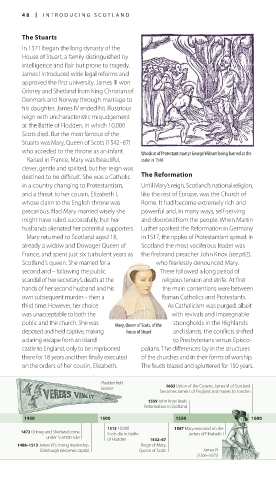
pub lic and the church. She was Mary, Queen of Scots, of the strongholds in the Highlands In 1745 James VII’s grandson, Prince
deposed and held captive, making House of Stuart and islands, the conflicts shifted Charles Edward Stuart, secretly
a daring escape from an island to Presbyterians versus Episco- entered Scotland, land ing on the
castle to England, only to be impris oned palians. The differences lay in the struc tures west Highland coast with seven men
there for 18 years and then finally executed of the churches and in their forms of worship. and a promise of French military Feather-capped Scottish Jacobites being attacked by Royalists at Glen Shiel
on the orders of her cousin, Elizabeth. The feuds blazed and spluttered for 150 years. support, which never materialized. in the Highlands, 1719
Flodden field MacDonald
banner 1603 Union of the Crowns. James VI of Scotland 1642 Civil shield
becomes James I of England and moves to London 1692 Massacre of Glencoe – a
war in Campbell-led force murders its 1745–6 Jacobite rising. Bonnie Prince
England Charlie tries to recover throne, but loses
1559 John Knox leads hosts, the MacDonalds, as an
Reformation in Scotland official punitive example the Battle of Culloden and flees
1450 1500 1550 16001600 1650 1700 1750
1513 10,000 1587 Mary executed on the
1472 Orkney and Shetland come Scots die in Battle orders of Elizabeth I 1689 James VII loses throne as he 1746 Abolition of Feudal Jurisdictions
under Scottish rule tries to restore Catholicism
of Flodden 1542–67 1726 Roadbuilding under General Wade
1488–1513 James IV’s strong leadership. Reign of Mary, 1698 First Darien (Panama) Expedition to found a
Edinburgh becomes capital Queen of Scots James VI trading colony. Bank of Scotland established 1706–7 Union of Parliaments.
(1566–1625) Scottish Parliament dissolved
048-049_EW_Scotland.indd 48 10/23/17 11:56 AM 048-049_EW_Scotland.indd 49 10/23/17 11:56 AM

