


Page 49 - (DK Eyewitness) Travel Guide - Scotland
P. 49
THE HIST OR Y OF SC O TLAND 47
David I tried to impose this system in the man, lost. William Wallace rose and led a
north, but the region remained out of his revolt that rekindled hope until his capture
con trol and, indeed, had its own “kings” – and execution six years later. His cause was
the Lords of the Isles. In the Highlands taken up by Robert the Bruce who,
a different social structure based against all odds, won support and
on kinship – that of families, or clans raised an army that changed the
– had evolved. The chief was a course of history by winning a
patriarch who held land, not decisive victory over the English at
privately, but on behalf of his the Battle of Bannockburn, near
people. It was an inheritable Stirling, on 23 June 1314.
position, but the chief remained Confronted by the largest English
accoun table to the clan and could The lion of Scotland, army to cross the border, the Scots
be removed by common consent, dating from 1222 were out number ed three to one,
unlike the feudal land lords whose and their arms were inferior. Yet
power was vested through legal title to the Bruce had chosen his ground and his strategy
land. This subtle difference was mirrored on carefully and, despite the enemy’s skilful
a national level – in England, the monarch bowmen and heavy cavalry, the Scots
was the King of England; in Scotland, he gained the vic tory they so badly needed.
was known as the King of Scots. Scotland had won back its indepen dence,
but it was not until 1329 that its sovereign
The Wars of Independence and the status was recognized and secured by a
Battle of Bannockburn Papal bull (six days after Bruce had died).
In 1222 the lion of Scotland’s coat of arms Even so, the wars with England would
first appeared on the great seal of Alexander continue for another 300 years.
II. This was during a relatively
peaceful interlude among frequent
periods of tur moil when it seemed
that Scotland was in danger of
breaking apart.
When Alexander III’s infant
daughter died in 1290, there was
no heir to the throne. Edward I of
England installed a puppet king
and, in 1296, led a devastating
invasion that carried off the Stone
of Destiny – the Scots’ coronation
throne – and earned him the title
“Hammer of the Scots”. Scotland
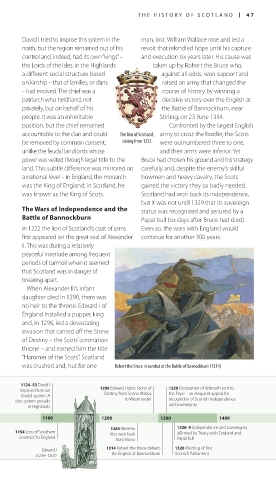
was crushed and, but for one Robert the Bruce in combat at the Battle of Bannockburn (1314)
1124–53 David I
imposes Norman 1296 Edward I takes Stone of 1320 Declaration of Arbroath sent to
feudal system. A Destiny from Scone Abbey the Pope – an eloquent appeal for
clan system prevails to Westminster recognition of Scottish independence
in Highlands and sovereignty
1000 1100 1200 1300 1400
1263 Western 1328–9 Independence and sovereignty
1154 Loss of “southern Isles won back affirmed by Treaty with England and
counties” to England
from Norse Papal bull
Edward I 1314 Robert the Bruce defeats 1326 Meeting of first
(1239–1307) the English at Bannockburn Scottish Parliament
046-047_EW_Scotland.indd 47 10/23/17 11:56 AM

