


Page 52 - (DK Eyewitness) Travel Guide - Scotland
P. 52
50 INTRODUCING SC O TLAND THE HIST OR Y OF SC O TLAND 51
Cogs Piston popular and sporting estates all the rage for Smith and the “Bard of in 1970, around the time that
hunting deer, the inland glens were as empty Humanity”, Robert Burns. North Sea oil wealth became
Boiler as they are today. In the 19th century, a factor in the Scottish
Scotland’s architecture economy and increased
Industrialization and the led the way in Europe, confidence in its ability to
Scottish Enlightenment as epitomized by the stand alone. In 1997, a large
While the Highlands were emptying, parts development of Edin burgh’s majority of Scots voted for
of southern Scotland were booming. For New Town (see pp70–71). the 1999 re-establishment
a large part of the 18th century Glasgow’s This bold plan to create a of a Scottish Parliament with
tobacco lords operated a lucrative residential centre away from a devolved authority over
stranglehold on the European market, the congested Old Town health, education and local
and linen, cotton and coal in their turn was begun in 1770, and the government, but incomplete
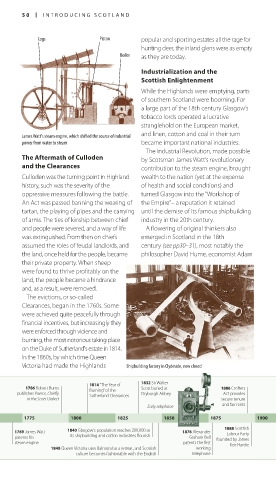
James Watt's steam engine, which shifted the source of industrial
power from water to steam became important national industries. design was greatly expanded tax-raising powers. The SNP
The Industrial Revolution, made possible in 1822 to produce a model A North Sea oil rig, providing prosperity has ruled here since 2007, and
The Aftermath of Culloden by Scotsman James Watt’s revolutionary of ele gance that is outstanding in the late 20th century put a referendum for Scottish
and the Clearances contribution to the steam engine, brought to this day. Among those who indepen dence on the agenda
Culloden was the turning point in Highland wealth to the nation (yet at the expense have occupied these classic Georgian for 2014. This was rejected, but by a margin
history, such was the severity of the of health and social conditions) and houses was Sir Walter Scott, one of the so narrow that it seemed unlikely to be the
oppressive measures following the battle. turned Glasgow into the “Workshop of world’s earliest best-selling novelists. end of the matter. This was confirmed in
An Act was passed banning the wearing of the Empire”– a reputation it retained In this same period, known as the Scottish 2015 when the SNP won 56 of 59 available
tartan, the playing of pipes and the carrying until the demise of its famous shipbuilding Enlightenment, Thomas Telford excelled in seats (although nearly half were lost again in
of arms. The ties of kinship between chief industry in the 20th century. engineering and, ever increasingly, Scots 2017’s snap election), and calls for indepen-
and people were severed, and a way of life A flowering of original thinkers also were finding fame and fortune abroad by dence were reignited when Scotland voted
was extinguished. From then on chiefs emerged in Scotland in the 18th exploring and developing foreign lands. to stay in the EU in the 2016 Brexit referendum.
assumed the roles of feudal landlords, and century (see pp30–31), most notably the
the land, once held for the people, became philosopher David Hume, economist Adam The Process of Devolution
their private prop erty. When sheep Soon after the 1707 Act of Union, it became
were found to thrive profitably on the clear that England and Scotland would
land, the people became a hindrance never be equal partners. With the political
and, as a result, were removed. centre in London’s Westminster, many Scots
The evictions, or so-called who wanted to make a mark in politics
Clearances, began in the 1760s. Some were forced to leave Scotland. This, and a
were achieved quite peacefully through system generally weighted towards English
financial incen tives, but increasingly they affairs, caused a general feeling of apathy
were enforced through violence and and impo tence to spread across Scotland.
burning, the most notorious taking place The Scottish National Party (SNP) was
on the Duke of Sutherland's estate in 1814. founded in 1934 and, though its separatist
In the 1860s, by which time Queen ideology initially seemed extremist to many, The main chamber of the Scottish Parliament building, in central
Victoria had made the Highlands Shipbuilding factory in Clydeside, now closed they finally won their first seat at Westminster Edinburgh, which opened in 2004
1832 Sir Walter 1967 North Sea oil 1999 Scottish Parliament
1814 “The Year of 1914–18 74,000 Scots die in World War I
1786 Robert Burns Burning” of the Scott buried at 1886 Crofters exploration begins re-established
publishes Poems, Chiefly Sutherland Clearances Dryburgh Abbey Act provides 1931 Economic slump –
in the Scots Dialect secure tenure 65 per cent unemployment 1996 Stone of Destiny (see 2015 SNP win another
and fair rents landslide majority and begin
Early telephone in Clyde shipyards p64) returns to Scotland a third term in government
1775 1800 1825 1850 1875 19001900 1925 1950 1975 2000 2025
1769 James Watt 1840 Glasgow's population reaches 200,000 as 1876 Alexander 1888 Scottish 1920s Hugh 1945 Alexander Fleming 2004 2016 UK votes to leave
Labour Party
patents his its shipbuilding and cotton industries flourish Graham Bell founded by James MacDiarmid wins Nobel Prize Opening of the EU in referendum
steam engine patents the first Keir Hardie reinstates Scots 1934 Scottish National new Scottish
1848 Queen Victoria uses Balmoral as a retreat, and Scottish working as literary Party founded Parliament 2014 Referendum narrowly
culture becomes fashionable with the English telephone language Stone of Destiny building rejects Scottish independence
050-051_EW_Scotland.indd 50 10/23/17 11:48 AM 050-051_EW_Scotland.indd 51 10/23/17 11:48 AM

