


Page 17 - All About History - Issue 59-17
P. 17
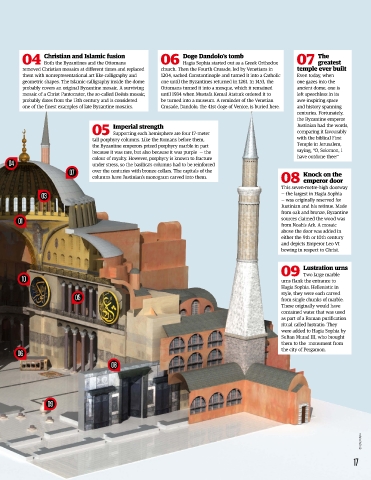
Christian and Islamic fusion                    Doge Dandolo’s tomb                             The
         04  Both the Byzantines and the Ottomans        06  Hagia Sophia started out as a Greek Orthodox   07  greatest
         removed Christian mosaics at different times and replaced   church. Then the Fourth Crusade, led by Venetians in   temple ever built
         them with nonrepresentational art like calligraphy and   1204, sacked Constantinople and turned it into a Catholic   Even today, when
         geometric shapes. The Islamic calligraphy inside the dome   one until the Byzantines returned in 1261. In 1453, the   one gazes into the
         probably covers an original Byzantine mosaic. A surviving   Ottomans turned it into a mosque, which it remained   ancient dome, one is
         mosaic of a Christ Pantocrator, the so-called Deësis mosaic,   until 1934 when Mustafa Kemal Ataturk ordered it to   left speechless in its
         probably dates from the 13th century and is considered   be turned into a museum. A reminder of the Venetian   awe-inspiring space
         one of the finest examples of late Byzantine mosaics.   Crusade, Dandolo, the 41st doge of Venice, is buried here.   and history spanning
                                                                                                         centuries. Fortunately,
                                                                                                         the Byzantine emperor
                                         Imperial strength                                               Justinian had the words,
                                 05  Supporting each hemisphere are four 17–meter                        comparing it favourably
                                 tall porphyry columns. Like the Romans before them,                     with the biblical First
                                 the Byzantine emperors prized porphyry marble in part                   Temple in Jerusalem,
                                 because it was rare, but also because it was purple  — the              saying, “O, Solomon, I
                                 colour of royalty. However, porphyry is known to fracture               have outdone thee!”
    04                           under stress, so the basilica’s columns had to be reinforced
                         07      over the centuries with bronze collars. The capitals of the                Knock on the
                                 columns have Justinian’s monogram carved into them.
                                                                                                    08  emperor door
                                                                                                    This seven-metre-high doorway
                03                                                                                  — the largest in Hagia Sophia
                                                                                                    — was originally reserved for
                                                                                                    Justinian and his retinue. Made
                                                                                                    from oak and bronze, Byzantine
       01                                                                                           sources claimed the wood was
                                                                                                    from Noah’s Ark. A mosaic
                                                                                                    above the door was added in
                                                                                                    either the 9th or 10th century
                                                                                                    and depicts Emperor Leo VI
                                                                                                    bowing in respect to Christ.


                                                                                                            Lustration urns
                                                                                                    09  Two large marble
         10                                                                                         urns flank the entrance to
                                                                                                    Hagia Sophia. Hellenistic in
                                                                                                    style, they were each carved
                           05                                                                       from single chunks of marble.
                                                                                                    These originally would have
                                                                                                    contained water that was used
                                                                                                    as part of a Roman purification
                                                                                                    ritual called lustratio. They
                                                                                                    were added to Hagia Sophia by
                                                                                                    Sultan Murad III, who brought
                                                                                                    them to the  monument from
                                                                                                    the city of Pergamon.
       06
                                        08


                  09


                                                                                                                                © Adrian Mann


                                                                                                                             17

