


Page 20 - All About History - Issue 59-17
P. 20
the Byzantine empiRe


         Day in the life


        Chariot raCer


        Chariot raCers dreamed of glory

        and suCCess in the hippodrome

        Byzantine empire, 500-42


              Chariot racing was the most popular spectator sport in the Byzantine
              Empire. Races took place in Constantinople’s Hippodrome circus, which
              could seat up to 100,000 people at once. Spectators from all classes,
              including the emperor, enjoyed the games as a distraction from their
              daily life while the racers themselves were normally slaves. The
              racers were divided into four team, which inspired the same fierce
              loyalty as modern football teams. In fact, fans of rival teams
              often brawled in the aisles. The races were also a prime
              opportunity for the emperor to present himself to the
              public, something that otherwise rarely occurred.

                pre-game show

                As the racers arrived to prepare for a day of
                competing, a wide array of entertainments were
                put on for the spectators to enjoy like wrestling,
                dancing, juggling, tightrope walks and wild beast
                fights. The emperor and his consort would be
                seated in their booth, called a Kathisma, which
                was directly linked to the Great Palace.

                represent the team

                There were four factions that raced in the
                Hippodrome — Blue, Green, Red and White. Racers
                would wear tunics that sported the colour of their
                team so that the crowd could easily identify them.
                Out of the four, it was the Blue and Green teams
                that were the most prominent, with the Red and
                White teams seen as the secondary factions.
                Better safe than sorry


                Chariot races were extremely dangerous and
                racers needed to wear protective gear.
                Leather pads for the thighs and chest
                were common along with leather
                helmets. A sharp knife was also a
                must in case the chariot’s reigns
                became entangled and the racer
                needed to cut himself free.

                play fair

                Lots were drawn to determine which
                of the 12 starting gates, known as
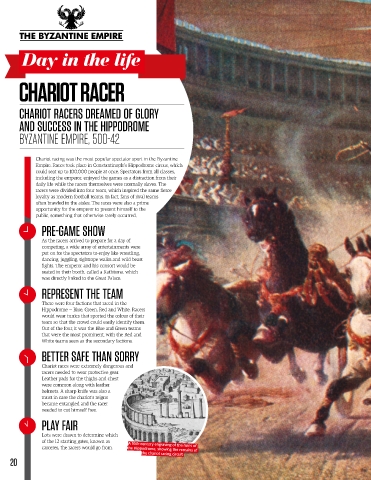
                                              A 16th-century engraving of the ruins of
                carceres, the racers would go from.   the Hippodrome, showing the remains of
                                                   the chariot racing circuit
     20

