


Page 16 - All About History - Issue 59-17
P. 16
the Byzantine empiRe


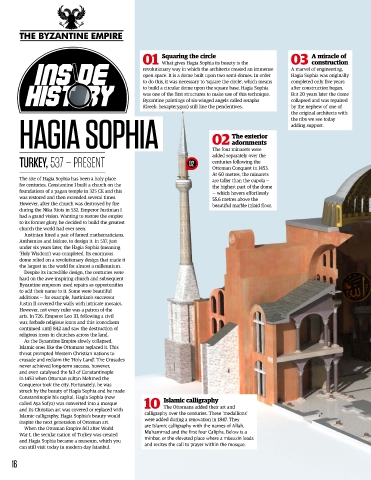
                                                          Squaring the circle                                  A miracle of
                                                   01  What gives Hagia Sophia its beauty is the       03 construction
                                                   revolutionary way in which the architects created an immense   A marvel of engineering,
                                                   open space. It is a dome built upon two semi-domes. In order   Hagia Sophia was originally
                                                   to do this, it was necessary to ‘square the circle’, which means   completed only five years
                                                   to build a circular dome upon the square base. Hagia Sophia   after construction began.
                                                   was one of the first structures to make use of this technique.   But 20 years later the dome
                                                   Byzantine paintings of six-winged angels called seraphs   collapsed and was repaired
                                                   (Greek: hexapterygon) still line the pendentives.   by the nephew of one of
                                                                                                       the original architects with
        HAGIA SOPHIA                                                              The exterior         adding support.
                                                                                                       the ribs we see today


                                                                            02 adornments
                                                                            The four minarets were
                                                                            added separately over the
        Turkey, 537 – Present                                      02       centuries following the
                                                                            Ottoman Conquest in 1453.
                                                                            At 60 metres, the minarets
        The site of Hagia Sophia has been a holy place                      are taller than the cupola —
        for centuries. Constantine I built a church on the                  the highest part of the dome
        foundations of a pagan temple in 325 CE and this                    — which hovers effortlessly
        was restored and then extended several times.                       55.6 metres above the
        However, after the church was destroyed by fire                     beautiful marble inlaid floor.
        during the Nika Riots in 532, Emperor Justinian I
        had a grand vision. Wanting to restore the empire
        to its former glory, he decided to build the greatest
        church the world had ever seen.
          Justinian hired a pair of famed mathematicians,
        Anthemios and Isidore, to design it. In 537, just
        under six years later, the Hagia Sophia (meaning
        ‘Holy Wisdom’) was completed. Its enormous
        dome relied on a revolutionary design that made it
        the largest in the world for almost a millennium.
          Despite its incredible design, the centuries were
        hard on the awe-inspiring church and subsequent
        Byzantine emperors used repairs as opportunities
        to add their name to it. Some were beautiful
        additions — for example, Justinian’s successor
        Justin II covered the walls with intricate mosaics.
        However, not every ruler was a patron of the
        arts. In 726, Emperor Leo III, following a civil
        war, forbade religious icons and this iconoclasm
        continued until 842 and saw the destruction of
        religious icons in churches across the land.
          As the Byzantine Empire slowly collapsed,
        Islamic ones like the Ottomans replaced it. This
        threat prompted Western Christian nations to
        crusade and reclaim the ‘Holy Land’. The Crusades
        never achieved long-term success, however,
        and even catalysed the fall of Constantinople
        in 1453 when Ottoman sultan Mehmed the
        Conqueror took the city. Fortunately, he was
        struck by the beauty of Hagia Sophia and he made
        Constantinople his capital. Hagia Sophia (now      Islamic calligraphy
        called Aya Sofya) was converted into a mosque
        and its Christian art was covered or replaced with   10  The Ottomans added their art and
        Islamic calligraphy. Hagia Sophia’s beauty would   calligraphy over the centuries. These ‘medallions’
        inspire the next generation of Ottoman art.  were added during a renovation in 1847. They
          When the Ottoman Empire fell after World    are Islamic calligraphy with the names of Allah,
        War I, the secular nation of Turkey was created   Muhammad and the first four Caliphs. Below is a
        and Hagia Sophia became a museum, which you   minbar, or the elevated place where a müezzin leads
        can still visit today in modern-day Istanbul.   and recites the call to prayer within the mosque.

     16

