


Page 33 - All About History - Issue 59-17
P. 33
However, these ordeals could be much tougher
       with trials like walking across hot coals, carrying
       heated rocks or plunging hands into boiling water
       to pick out a hot iron. If there burns didn’t become
       infected within three days, they were innocent.
         Besides perjury, the Thing had to contend with
       jury tampering. Powerful clans might bribe or
       threaten violence against free men to sway their
       votes. Sometimes it was even more insidious: free
       men might be more favourable to clans they owed
       some allegiance to or they could be prejudiced
       against sworn enemies.
         Not unlike modern trial, the dispute was
       concluded when the jury unanimously voted on
       the best way to resolve it. The chieftain would
       then consider this when making a judgement.
       However, a crucial difference is that even though
       the Thing would decide upon a dispute and pass a
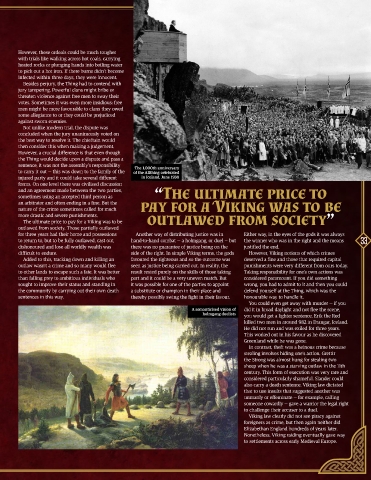
       sentence, it was not the assembly’s responsibility   The 1,000th anniversary
       to carry it out — this was down to the family of the   of the Allthing celebrated
       injured party and it could take several different   in Iceland, June 1930
       forms. On one level there was civilised discussion
       and an agreement made between the two parties,   “The ultimate price to
       sometimes using an accepted third person as
       an arbitrator and often ending in a fine. But the   pay for a Viking was to be
       nature of the crime sometimes called for much
       more drastic and severe punishments.
         The ultimate price to pay for a Viking was to be   outlawed from society”
       outlawed from society. Those partially outlawed
       for three years had their home and possessions   Another way of distributing justice was in   Either way, in the eyes of the gods it was always
       to return to, but to be fully outlawed, cast out,   hand-to-hand combat — a holmgang, or duel — but   the winner who was in the right and the means   33
       dishonoured and lose all worldly wealth was   there was no guarantee of justice being on the   justified the end.
       difficult to endure.                    side of the right. In simple Viking terms, the gods   However, Viking notions of which crimes
         Added to this, tracking down and killing an   favoured the righteous and so the outcome was   deserved a fine and those that required capital
       outlaw wasn’t a crime and so many would flee   seen as justice being carried out. In reality, the   punishments were very different from ours today.
       to other lands to escape such a fate. It was better   result rested purely on the skills of those taking   Taking responsibility for one’s own actions was
       than falling prey to ambitious individuals who   part and it could be a very uneven match. But   considered paramount. If you did something
       sought to improve their status and standing in   it was possible for one of the parties to appoint   wrong, you had to admit to it and then you could
       the community by carrying out their own death   a substitute or champion in their place and   defend yourself at the Thing, which was the
       sentences in this way.                  thereby possibly swing the fight in their favour.   honourable way to handle it.
                                                                                        You could even get away with murder — if you
                                                                    A romanticised vision of   did it in broad daylight and not flee the scene,
                                                                        holmgang duelists  you would get a lighter sentence. Erik the Red
                                                                                       killed two men in around 982 in Drangar, Iceland.
                                                                                       He did not run and was exiled for three years.
                                                                                       This worked out in his favour as he discovered
                                                                                       Greenland while he was gone.
                                                                                        In contrast, theft was a heinous crime because
                                                                                       stealing involves hiding one’s action. Grettir
                                                                                       the Strong was almost hung for stealing two
                                                                                       sheep when he was a starving outlaw in the 11th
                                                                                       century. This form of execution was very rare and
                                                                                       considered particularly shameful. Slander could
                                                                                       also carry a death sentence. Viking law dictated
                                                                                       that to use insults that suggested another was
                                                                                       unmanly or effeminate — for example, calling
                                                                                       someone cowardly — gave a warrior the legal right
                                                                                       to challenge their accuser to a duel.
                                                                                        Viking law clearly did not see piracy against
                                                                                       foreigners as crime, but then again neither did
                                                                                       Elizabethan England hundreds of years later.
                                                                                       Nonetheless, Viking raiding eventually gave way
                                                                                       to settlements across early Medieval Europe.

