


Page 34 - All About History - Issue 59-17
P. 34
Norse culture


        The Norwegians settled in Scotland, Ireland and   that the Danelaw was any more lawless than
        Iceland; the Swedes in Russia, the Baltic, and   neighbouring Wessex. In fact, Viking justice has
        Eastern Europe; the Danes in England and France.  left a legacy that endures to this day — the English
          With the flourishing of Viking settlements came   word ‘law’ derives directly from Old Norse.
        the spread of their laws. Archaeological evidence   As a system of law and order, the Thing had its
        for Things have been found in the Isle of Man, the   faults, such as being open to corruption and overly
        Faroe Islands, Scotland and beyond. In many of   reliant on an unswerving belief in the will of the
        these places, honorary Things still assemble.  gods. But it was inclusive, giving the ordinary man
          In England, meanwhile, the Danelaw   a voice and placing the strong Viking values of
        represented a geographical area negotiated   honour and fairness at its core. It was this strength
        through various battles and treaties but it was   that was to carry it through many years of change,
        the foundation of many aspects of modern law   ensuring that smash-and-grab raiders could spread
        that we know today. Far from being oppressed   their influence throughout entire countries and on
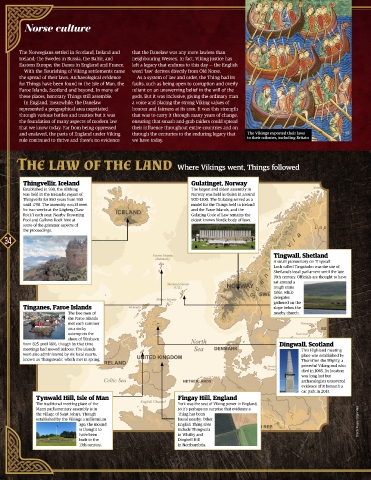
        and enslaved, the parts of England under Viking   through the centuries to the enduring legacy that   The Vikings exported their laws
        rule continued to thrive and there’s no evidence   we have today.               to their colonies, including Britain


       The law of the land Where Vikings went, Things followed

         Thingvellir, Iceland                                       Gulatinget, Norway
         Established in 930, the Allthing                           The largest and oldest assembly in
         was held in the Icelandic region of                        Norway was held in Gulen in around
         Thingvellir for 850 years from 930                         900-1300. The Gulating served as a
         until 1798. The assembly would meet                        model for the Things held in Iceland
         for two weeks at the Lögberg (‘Law                         and the Faroe Islands, and the
         Rock’) each year. Nearby Drowning                          Gulating Code of Law remains the
         Pool and Gallows Rock hint at                              oldest known Nordic body of laws.
         some of the grimmer aspects of
         the proceedings.
   34

                                                                                                 Tingwall, Shetland
                                                                                                 A small promontory on Tingwall
                                                                                                 Loch called Tingaholm was the site of
                                                                                                 Shetland’s local parliament until the late
                                                                                                 16th century. Officials are thought to have
                                                                                                 sat around a
                                                                                                 rough stone
                                                                                                 table, while
                                                                                                 delegates
                                                                                                 gathered on the
         Tinganes, Faroe Islands                                                                 slope below the
                         The free men of                                                         nearby church.
                         the Faroe Islands
                         met each summer
                         on a rocky
                         outcrop on the
                         shore of Tórshavn
         from 825 until 1816, though by that time                                                  Dingwall, Scotland
         meetings had moved indoors. The islands                                                           This Highland meeting
         were also administered by six local courts,                                                       place was established by
         known as ‘thingsteads’, which met in spring.                                                      Thornfinn the Mighty, a
                                                                                                           powerful Viking earl who
                                                                                                           died in 1065. Its location
                                                                                                           was long lost but
                                                                                                           archaeologists uncovered
                                                                                                           evidence of it beneath a
                                                                                                           car park in 2013.
              Tynwald Hill, Isle of Man                         Fingay Hill, England
              The traditional meeting place of the              York was the seat of Viking power in England,
              Manx parliamentary assembly is in                 so it’s perhaps no surprise that evidence a
              the village of Saint John’s. Though               Thing has been
              established by the Vikings a millennium           found nearby. Other
                             ago, the mound                     English Thing sites                                            © Getty Images, Google Maps
                             is thought to                      include Thingwala
                             have been                          in Whitby and
                             built in the                       Dingbell Hill
                             13th century.                      in Northumbria.

