


Page 108 - (DK) The Business Book
P. 108
106 ORGANIZATIONAL CULTURE


          IN CONTEXT
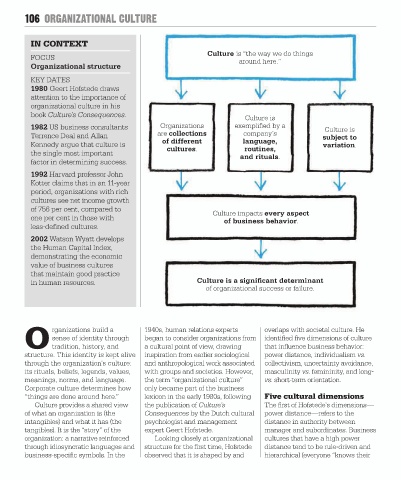
                                                          Culture is “the way we do things
          FOCUS
                                                                   around here.”
          Organizational structure
          KEY DATES
          1980 Geert Hofstede draws
          attention to the importance of
          organizational culture in his
          book Culture’s Consequences.
                                                                     Culture is
          1982 US business consultants       Organizations        exemplified by a          Culture is
          Terrence Deal and Allan           are collections         company’s             subject to
                                              of different          language,
          Kennedy argue that culture is                                                   variation.
                                               cultures.            routines,
          the single most important
                                                                   and rituals.
          factor in determining success.
          1992 Harvard professor John
          Kotter claims that in an 11-year
          period, organizations with rich
          cultures see net income growth
          of 756 per cent, compared to
                                                            Culture impacts every aspect
          one per cent in those with
                                                               of business behavior.
          less-defined cultures.
          2002 Watson Wyatt develops
          the Human Capital Index,
          demonstrating the economic
          value of business cultures
          that maintain good practice
          in human resources.                          Culture is a significant determinant
                                                          of organizational success or failure.


               rganizations build a      1940s, human relations experts   overlaps with societal culture. He
               sense of identity through   began to consider organizations from  identified five dimensions of culture
        O tradition, history, and        a cultural point of view, drawing   that influence business behavior:
        structure. This identity is kept alive   inspiration from earlier sociological   power distance, individualism vs.
        through the organization’s culture:   and anthropological work associated   collectivism, uncertainty avoidance,
        its rituals, beliefs, legends, values,   with groups and societies. However,   masculinity vs. femininity, and long-
        meanings, norms, and language.   the term “organizational culture”   vs. short-term orientation.
        Corporate culture determines how   only became part of the business
        “things are done around here.”   lexicon in the early 1980s, following   Five cultural dimensions
           Culture provides a shared view    the publication of Culture’s   The first of Hofstede’s dimensions—
        of what an organization is (the   Consequences by the Dutch cultural   power distance—refers to the
        intangibles) and what it has (the   psychologist and management   distance in authority between
        tangibles). It is the “story” of the   expert Geert Hofstede.     manager and subordinates. Business
        organization: a narrative reinforced   Looking closely at organizational   cultures that have a high power
        through idiosyncratic languages and   structure for the first time, Hofstede   distance tend to be rule-driven and
        business-specific symbols. In the   observed that it is shaped by and   hierarchical (everyone “knows their

