


Page 109 - (DK) The Business Book
P. 109
LIGHTING THE FIRE       107

        See also: Creativity and invention 72–73   ■  Gods of management 76–77   ■  Hubris and nemesis 100–103   ■  Avoid groupthink
        114   ■  Balancing long- versus short-termism 190–91   ■  The learning organization 202–07   ■  Creating an ethical culture 224–25


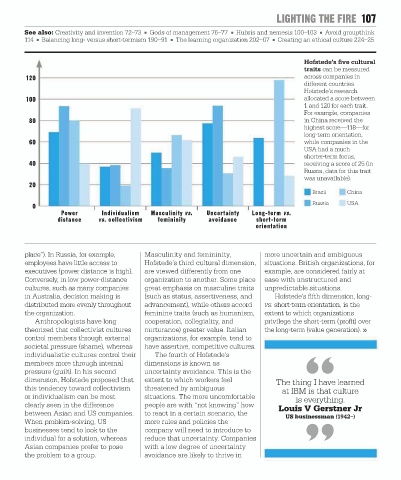
                                                                                     Hofstede’s five cultural
                                                                                     traits can be measured
        120                                                                          across companies in
                                                                                     different countries.
                                                                                     Hofstede’s research
        100                                                                          allocated a score between
                                                                                     1 and 120 for each trait.
                                                                                     For example, companies
         80                                                                          in China received the
                                                                                     highest score—118—for
                                                                                     long-term orientation,
         60                                                                          while companies in the
                                                                                     USA had a much
                                                                                     shorter-term focus,
         40                                                                          receiving a score of 25 (in
                                                                                     Russia, data for this trait
                                                                                     was unavailable).
         20
                                                                                       Brazil    China
                                                                                       Russia    USA
          0
                  Power      Individualism    Masculinity vs.   Uncertainty   Long-term vs.
                 distance   vs. collectivism  femininity   avoidance    short-term
                                                                        orientation


        place”). In Russia, for example,   Masculinity and femininity,    more uncertain and ambiguous
        employees have little access to   Hofstede’s third cultural dimension,  situations. British organizations, for
        executives (power distance is high).   are viewed differently from one   example, are considered fairly at
        Conversely, in low power-distance   organization to another. Some place  ease with unstructured and
        cultures, such as many companies   great emphasis on masculine traits   unpredictable situations.
        in Australia, decision making is   (such as status, assertiveness, and   Hofstede’s fifth dimension, long-
        distributed more evenly throughout   advancement), while others accord   vs. short-term orientation, is the
        the organization.                feminine traits (such as humanism,   extent to which organizations
           Anthropologists have long     cooperation, collegiality, and   privilege the short-term (profit) over
        theorized that collectivist cultures   nurturance) greater value. Italian   the long-term (value generation). ❯❯
        control members through external   organizations, for example, tend to
        societal pressure (shame), whereas   have assertive, competitive cultures.
        individualistic cultures control their   The fourth of Hofstede’s
        members more through internal    dimensions is known as
        pressure (guilt). In his second   uncertainty avoidance. This is the
        dimension, Hofstede proposed that   extent to which workers feel     The thing I have learned
        this tendency toward collectivism   threatened by ambiguous            at IBM is that culture
        or individualism can be most     situations. The more uncomfortable        is everything.
        clearly seen in the difference   people are with “not knowing” how    Louis V Gerstner Jr
        between Asian and US companies.   to react in a certain scenario, the
                                                                                US businessman (1942–)
        When problem-solving, US         more rules and policies the
        businesses tend to look to the   company will need to introduce to
        individual for a solution, whereas   reduce that uncertainty. Companies
        Asian companies prefer to pose    with a low degree of uncertainty
        the problem to a group.          avoidance are likely to thrive in

