


Page 113 - (DK) The Business Book
P. 113
LIGHTING THE FIRE       111

        See also: From entrepreneur to leader 46–47   ■  Effective leadership 78–79   ■  Organizing teams and talent 80–85   ■
        Avoiding complacency 194–201   ■  The learning organization 202–07   ■  Kaizen 302–09


                                     Emotional intelligence has five components:


                                                   Motivation
          Self-awareness     Self-regulation        (a desire to        Empathy           Social skills
           (the ability to      (the ability                          (the ability to     (an ability to
           recognize and         to control        pursue goals        understand         find common
                                                   with energy)
            understand         impulses and                           other people’s       ground and
             emotions)          emotions)                               emotions)         build rapport)


        Goleman suggests that high EQ    that the answer is both: inherent   trigger points might be. This
        facilitates other essential leadership  personality traits are important in   procedure seeks to increase
        traits. For example, the ability to   leadership, but EQ—which grows   emotional maturity. A 1999 study
        recognize accurately what another   with age, experience, and self-  showed that partners in a
        person is feeling (empathy) enables   reflectiveness—is just as important.  multinational consulting company
        one to manage that feeling and any   Today, the development of EQ    who scored highly on EQ delivered
        behaviors that arise from it.    lies at the heart of leadership   $1.2 million more profit than other
                                         coaching. New and aspiring leaders  partners. Other studies have shown
        What makes a good leader?        are mentored by experienced ones;   similar correlations between EQ
        One persistent debate within the   together, they discuss past and   and effectiveness. Emotional
        business world is whether leaders   future scenarios, various possible   balance, it seems, is a key factor
        are born or made. Goleman suggests  responses, and what the emotional   in commercial success. ■

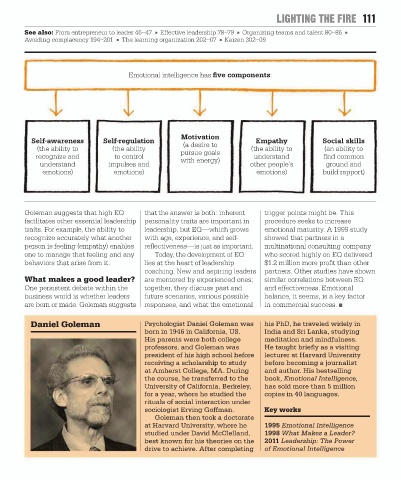
          Daniel Goleman                 Psychologist Daniel Goleman was   his PhD, he traveled widely in
                                         born in 1946 in California, US.    India and Sri Lanka, studying
                                         His parents were both college    meditation and mindfulness.
                                         professors, and Goleman was      He taught briefly as a visiting
                                         president of his high school before   lecturer at Harvard University
                                         receiving a scholarship to study    before becoming a journalist
                                         at Amherst College, MA. During   and author. His bestselling
                                         the course, he transferred to the   book, Emotional Intelligence,
                                         University of California, Berkeley,   has sold more than 5 million
                                         for a year, where he studied the   copies in 40 languages.
                                         rituals of social interaction under
                                         sociologist Erving Goffman.      Key works
                                            Goleman then took a doctorate
                                         at Harvard University, where he   1995 Emotional Intelligence
                                         studied under David McClelland,   1998 What Makes a Leader?
                                         best known for his theories on the   2011 Leadership: The Power
                                         drive to achieve. After completing   of Emotional Intelligence

