


Page 110 - (DK) The Business Book
P. 110
108 ORGANIZATIONAL CULTURE


        Japanese businesses, for example,   maintaining unified business   decisions, big and small, then they
        think very much in the long-term:   cultures, whether operating across   start to feel unloved and removed
        Toyota Motor Corporation has a    multiple national or international   from the business and its success.”
        100-year business plan.          cultures. The challenge is to balance
                                         the promotion of “one culture” within  Cultural benefits
        Why culture matters              an organization against the      Strong cultures give staff a sense
        Every organization’s culture has   influences of local cultures in    of belonging, which in turn brings
        varying degrees of these different   the external world.          benefits, such as job satisfaction and
        dimensions. The best leaders know   Companies with strong         staff retention. At Nike, staff are
        which cultures operate within    cultures, such as Nike and India’s   considered rookies if they have been
        different parts of their organization   Tata Motors, are intensely aware of   at the company for less than a
        (and within different parts of the   their history and image. At Nike it   decade. Moreover, culture defines
        world), and adjust their leadership   is not unusual for employees to   “the rules of the game,” simplifying
        style to suit—valuing collective   have the company’s “swoosh” logo   priorities. Decision making is faster
        approaches, for example, when    tattooed on their body. At these   and easier if everyone understands
        dealing with Asian subsidiaries.  businesses, culture encompasses   company values, beliefs, and vision.
           Today, organizational culture is   an internalized sense of “who we   Deeply embedded cultures also
        more important than ever before.   are” and “what we stand for” to   improve the customer experience; if
        Increasingly competitive markets,   such an extent that many of the   staff believes in the product, they
        globalization, the prevalence of   staff are able to recite corporate   will transfer this belief to customers.
        mergers, acquisitions, and alliances,   maxims from memory. Similarly,   Culture also protects an
        and new modes of working (such as   the UK smoothie company Innocent  organization from the whims of
        teleworking) require coordination   has worked hard to create a   charismatic leadership and the
        across vast numbers of staff and   corporate culture based on     fickleness of fashion. A leader may
        huge geographic distances.       communication. Dan Germain, the   influence corporate culture, but a
        Hofstede’s observations highlight   brand’s Head of Creative, explains:   successful culture should endure
        the difficulties that leaders face in   “if people aren’t involved in all   even when management changes.

                                                                          Features of culture
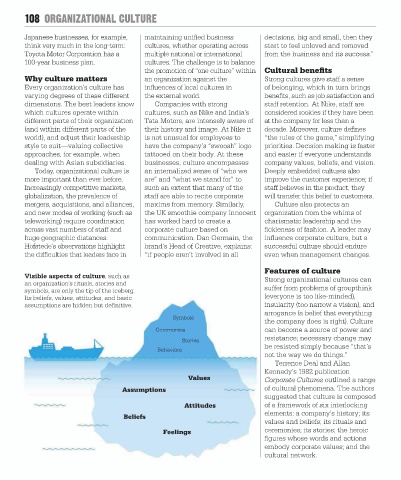
        Visible aspects of culture, such as                               Strong organizational cultures can
        an organization’s rituals, stories and
        symbols, are only the tip of the iceberg.                         suffer from problems of groupthink
        Its beliefs, values, attitudes, and basic                         (everyone is too like-minded),
        assumptions are hidden but definitive.                             insularity (too narrow a vision), and
                                                                          arrogance (a belief that everything
                                                 Symbols
                                                                          the company does is right). Culture
                                            Ceremonies                    can become a source of power and
                                                                          resistance; necessary change may
                                                   Stories
                                                                          be resisted simply because “that’s
                                            Behaviors
                                                                          not the way we do things.”
                                                                             Terrence Deal and Allan
                                                                          Kennedy’s 1982 publication
                                                     Values               Corporate Cultures outlined a range
                                   Assumptions                            of cultural phenomena. The authors
                                                                          suggested that culture is composed
                                                    Attitudes             of a framework of six interlocking
                                                                          elements: a company’s history; its
                                   Beliefs
                                                                          values and beliefs; its rituals and
                                              Feelings                    ceremonies; its stories; the heroic
                                                                          figures whose words and actions
                                                                          embody corporate values; and the
                                                                          cultural network.

