


Page 167 - (DK) The Business Book
P. 167
WORKING WITH A VISION         165

        See also: Managing risk 40–41   ■  Luck (and how to get lucky) 42   ■  Reinventing and adapting 52–57   ■  Creativity and
        invention 72–73   ■  Beware the yes-men 74–75   ■  Thinking outside the box 88–89   ■  The learning organization 202–07


        to “turn every disaster into an   this principle into their culture. US
        opportunity.” As the world turned   corporation 3M, for example, allows
        to electric lighting from kerosene oil  technical staff to allocate 15 percent
        lamps, his business was threatened.  of their time to experimenting with
        However, he quickly saw the      ideas, understanding that there will
        potential of Ford’s automobile and   be occasional winners (such as the   I have not failed.
        realized that oil could just as easily   Post-it Note) along with the   I’ve just found 10,000 ways
        be converted to gasoline as      repeated failures.                      that won’t work.
        kerosene. His fortune rocketed.     Recognizing error, cutting        Thomas A. Edison
                                         losses, spotting new opportunities,    US inventor (1847–1931)
        Constant learning                and changing course is a test of
        Personal experience is recognized   leadership and also sends out a
        as the way individuals learn, and it   positive message to those who
        is much the same for organizations;   work in the organization. It requires
        they gain knowledge and capability  rational, unemotional thought that
        from corporate experience. The   focuses on the costs and benefits
        pace of change in the global market   of changing direction.      The world’s third-largest retailer,
        means that constant improvement     In the mid-1980s, the Coca-Cola   Tesco, opened its Fresh & Easy
        has become the norm. The greatest   Company decided to replace its   stores in the US in 2007. After six
        challenge, however, is for       original formula with a sweeter   years and $2.27 billion in costs,
        companies to recognize failure and   product: New Coke. In the US, this   it admitted failure and pulled out.
        learn from it. In order to do this, an   prompted consumer protests. The   The stores were unsuccessful
        organization needs to build a    company learned that US consumers  because Tesco misjudged the
        culture in which people are not   were protective of Coca-Cola and    shopping habits of its target
        criticized or penalized for mistakes,   felt  unhappy about any tampering   customers. Chairman Richard
        but are actively encouraged to gain   with the recipe. The CEO quickly   Broadbent said they had learned
        useful insights from them.       reintroduced the original formula as   the value of remaining open-
           Some companies recognize that   Coke Classic. By responding quickly,  minded about projects. Flexibility,
        it is only through failure that   he grasped an opportunity for   feedback, and fast response are key
        success can be found, and build   significant publicity; sales soared.   to finding a new path via failure. ■

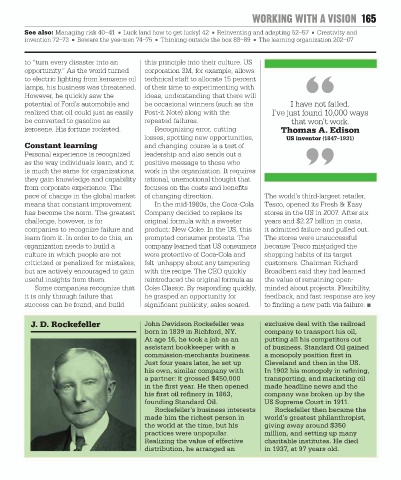
          J. D. Rockefeller              John Davidson Rockefeller was    exclusive deal with the railroad
                                         born in 1839 in Richford, NY.    company to transport his oil,
                                         At age 16, he took a job as an   putting all his competitors out
                                         assistant bookkeeper with a      of business. Standard Oil gained
                                         commission-merchants business.   a monopoly position first in
                                         Just four years later, he set up    Cleveland and then in the US.
                                         his own, similar company with    In 1902 his monopoly in refining,
                                         a partner: it grossed $450,000    transporting, and marketing oil
                                         in the first year. He then opened   made headline news and the
                                         his first oil refinery in 1863,    company was broken up by the
                                         founding Standard Oil.           US Supreme Court in 1911.
                                            Rockefeller’s business interests   Rockefeller then became the
                                         made him the richest person in   world’s greatest philanthropist,
                                         the world at the time, but his   giving away around $350
                                         practices were unpopular.        million, and setting up many
                                         Realizing the value of effective   charitable institutes. He died
                                         distribution, he arranged an     in 1937, at 97 years old.

