


Page 220 - (DK) The Business Book
P. 220
218


                                            IF YOU DON’T KNOW


                                               WHERE YOU ARE,


                                                A MAP WON’T HELP


                                         THE CAPABILITY MATURITY MODEL


                                                                                 usiness processes are a
          IN CONTEXT                                                             series of actions taken to
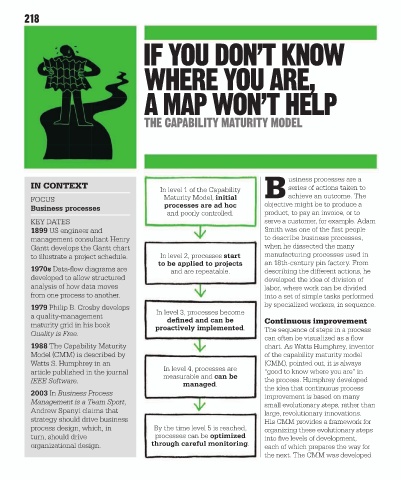
                                             In level 1 of the Capability
          FOCUS                               Maturity Model, initial     B achieve an outcome. The
                                              processes are ad hoc        objective might be to produce a
          Business processes
                                               and poorly controlled.     product, to pay an invoice, or to
          KEY DATES                                                       serve a customer, for example. Adam
          1899 US engineer and                                            Smith was one of the first people
          management consultant Henry                                     to describe business processes,
          Gantt develops the Gantt chart                                  when he dissected the many
          to illustrate a project schedule.   In level 2, processes start    manufacturing processes used in
                                             to be applied to projects    an 18th-century pin factory. From
          1970s Data-flow diagrams are           and are repeatable.       describing the different actions, he
          developed to allow structured                                   developed the idea of division of
          analysis of how data moves                                      labor, where work can be divided
          from one process to another.                                    into a set of simple tasks performed
                                                                          by specialized workers, in sequence.
          1979 Philip B. Crosby develops
                                            In level 3, processes become
          a quality-management
                                               defined and can be          Continuous improvement
          maturity grid in his book
                                            proactively implemented.      The sequence of steps in a process
          Quality is Free.
                                                                          can often be visualized as a flow
          1988 The Capability Maturity                                    chart. As Watts Humphrey, inventor
          Model (CMM) is described by                                     of the capability maturity model
          Watts S. Humphrey in an                                         (CMM), pointed out, it is always
                                              In level 4, processes are
          article published in the journal                                “good to know where you are” in
                                              measurable and can be
          IEEE Software.                                                  the process. Humphrey developed
                                                    managed.
                                                                          the idea that continuous process
          2003 In Business Process
                                                                          improvement is based on many
          Management is a Team Sport,
                                                                          small evolutionary steps, rather than
          Andrew Spanyi claims that
                                                                          large, revolutionary innovations.
          strategy should drive business                                  His CMM provides a framework for
          process design, which, in        By the time level 5 is reached,   organizing these evolutionary steps
          turn, should drive                processes can be optimized    into five levels of development,
          organizational design.           through careful monitoring.    each of which prepares the way for
                                                                          the next. The CMM was developed

