


Page 215 - (DK) The Business Book
P. 215
WORKING WITH A VISION         213

        See also: Study the competition 24–27   ■  Gaining an edge 32–39   ■  Leading the market 166–69   ■  Porter’s generic
        strategies 178–83   ■  Good and bad strategy 184–85   ■  The value chain 216–17


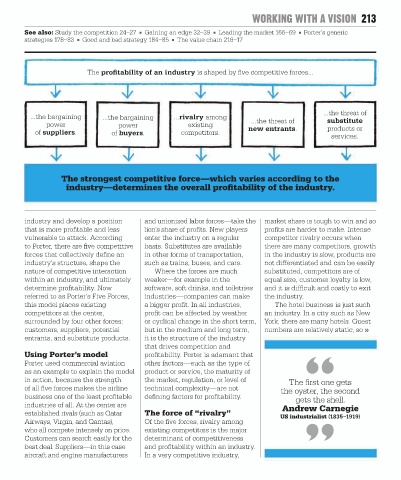
                         The profitability of an industry is shaped by five competitive forces...


                                                                                          ...the threat of
         ...the bargaining   ...the bargaining   ...rivalry among                          substitute
              power               power              existing         ...the threat of
           of suppliers.        of buyers.         competitors.      new entrants.         products or
                                                                                            services.


                  The strongest competitive force—which varies according to the
                   industry—determines the overall profitability of the industry.


        industry and develop a position   and unionized labor forces—take the  market share is tough to win and so
        that is more profitable and less   lion’s share of profits. New players   profits are harder to make. Intense
        vulnerable to attack. According    enter the industry on a regular   competitor rivalry occurs when
        to Porter, there are five competitive   basis. Substitutes are available    there are many competitors, growth
        forces that collectively define an   in other forms of transportation,   in the industry is slow, products are
        industry’s structure, shape the   such as trains, buses, and cars.   not differentiated and can be easily
        nature of competitive interaction   Where the forces are much     substituted, competitors are of
        within an industry, and ultimately   weaker—for example in the    equal size, customer loyalty is low,
        determine profitability. Now      software, soft drinks, and toiletries   and it is difficult and costly to exit
        referred to as Porter’s Five Forces,   industries—companies can make    the industry.
        this model places existing       a bigger profit. In all industries,   The hotel business is just such
        competitors at the center,       profit can be affected by weather    an industry. In a city such as New
        surrounded by four other forces:   or cyclical change in the short term,  York, there are many hotels. Guest
        customers, suppliers, potential   but in the medium and long term,    numbers are relatively static, so ❯❯
        entrants, and substitute products.     it is the structure of the industry
                                         that drives competition and
        Using Porter’s model             profitability. Porter is adamant that
        Porter used commercial aviation    other factors—such as the type of
        as an example to explain the model   product or service, the maturity of
        in action, because the strength    the market, regulation, or level of   The first one gets
        of all five forces makes the airline   technical complexity—are not    the oyster, the second
        business one of the least profitable   defining factors for profitability.   gets the shell.
        industries of all. At the center are                                   Andrew Carnegie
        established rivals (such as Qatar   The force of “rivalry”
                                                                              US industrialist (1835–1919)
        Airways, Virgin, and Qantas),    Of the five forces, rivalry among
        who all compete intensely on price.   existing competitors is the major
        Customers can search easily for the   determinant of competitiveness
        best deal. Suppliers—in this case   and profitability within an industry.
        aircraft and engine manufacturers   In a very competitive industry,

