


Page 275 - (DK) The Business Book
P. 275
SUCCESSFUL SELLING          273

        See also: Stand out in the market 28–31   ■  The AIDA model 242–43   ■  Focus on the future market 244–49   ■
        Creating a brand 258–63   ■  Make your customers love you 264–67   ■  Generating buzz 274–75


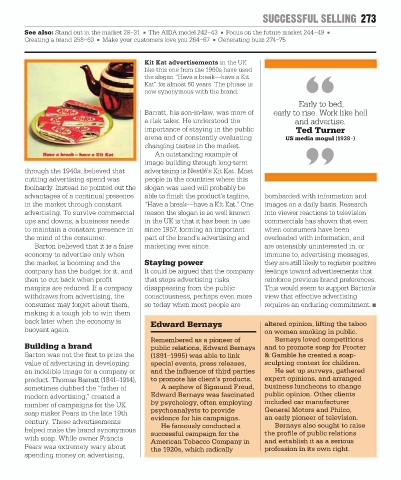
                                         Kit Kat advertisements in the UK
                                         like this one from the 1960s have used
                                         the slogan “Have a break—have a Kit
                                         Kat” for almost 60 years. The phrase is
                                         now synonymous with the brand.
                                                                                    Early to bed,
                                         Barratt, his son-in-law, was more of   early to rise. Work like hell
                                         a risk taker. He understood the          and advertise.
                                         importance of staying in the public       Ted Turner
                                         arena and of constantly evaluating     US media mogul (1938–)
                                         changing tastes in the market.
                                            An outstanding example of
                                         image building through long-term
        through the 1940s, believed that   advertising is Nestlé’s Kit Kat. Most
        cutting advertising spend was    people in the countries where this
        foolhardy. Instead he pointed out the  slogan was used will probably be
        advantages of a continual presence   able to finish the product’s tagline,   bombarded with information and
        in the market through constant   “Have a break—have a Kit Kat.” One   images on a daily basis. Research
        advertising. To survive commercial   reason the slogan is so well known   into viewer reactions to television
        ups and downs, a business needs   in the UK is that it has been in use   commercials has shown that even
        to maintain a constant presence in   since 1957, forming an important   when consumers have been
        the mind of the consumer.        part of the brand’s advertising and   overloaded with information, and
           Barton believed that it is a false   marketing ever since.     are ostensibly uninterested in, or
        economy to advertise only when                                    immune to, advertising messages,
        the market is booming and the    Staying power                    they are still likely to register positive
        company has the budget for it, and   It could be argued that the company   feelings toward advertisements that
        then to cut back when profit      that stops advertising risks     reinforce previous brand preferences.
        margins are reduced. If a company   disappearing from the public   This would seem to support Barton’s
        withdraws from advertising, the   consciousness, perhaps even more   view that effective advertising
        consumer may forget about them,   so today when most people are   requires an enduring commitment.  ■
        making it a tough job to win them
        back later when the economy is     Edward Bernays                 altered opinion, lifting the taboo
        buoyant again.                                                    on women smoking in public.
                                           Remembered as a pioneer of        Bernays loved competitions
        Building a brand                   public relations, Edward Bernays   and to promote soap for Procter
        Barton was not the first to prize the   (1891–1995) was able to link   & Gamble he created a soap-
        value of advertising in developing   special events, press releases,   sculpting contest for children.
        an indelible image for a company or   and the influence of third parties   He set up surveys, gathered
        product. Thomas Barratt (1841–1914),   to promote his client’s products.   expert opinions, and arranged
        sometimes dubbed the “father of      A nephew of Sigmund Freud,   business luncheons to change
        modern advertising,” created a     Edward Bernays was fascinated   public opinion. Other clients
        number of campaigns for the UK     by psychology, often employing   included car manufacturer
                                           psychoanalysts to provide      General Motors and Philco,
        soap maker Pears in the late 19th
                                           evidence for his campaigns.    an early pioneer of television.
        century. These advertisements
                                             He famously conducted a         Bernays also sought to raise
        helped make the brand synonymous
                                           successful campaign for the    the profile of public relations
        with soap. While owner Francis
                                           American Tobacco Company in    and establish it as a serious
        Pears was extremely wary about     the 1920s, which radically     profession in its own right.
        spending money on advertising,

