


Page 277 - (DK) The Business Book
P. 277
SUCCESSFUL SELLING         275

        See also: Understanding the market 234–41   ■         Creating a brand 258–63   ■     Memes and imitation
        Why advertise? 272–73   ■  Benchmarking 330–31
                                                                            In 1976 evolutionary biologist
                                                                            Richard Dawkins put forward
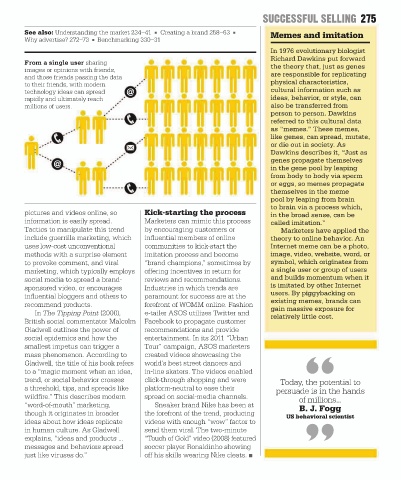
        From a single user sharing                                          the theory that, just as genes
        images or opinions with friends,
        and those friends passing the data                                  are responsible for replicating
        to their friends, with modern                                       physical characteristics,
        technology ideas can spread   @                                     cultural information such as
        rapidly and ultimately reach                                        ideas, behavior, or style, can
        millions of users.                                                  also be transferred from
                                                                            person to person. Dawkins
                                                                            referred to this cultural data
                                                                            as “memes.” These memes,
                                                                            like genes, can spread, mutate,
                                                                            or die out in society. As
                                                                            Dawkins describes it, “Just as
                                                                            genes propagate themselves
                @                                                           in the gene pool by leaping
                                                                            from body to body via sperm
                                                                            or eggs, so memes propagate
                                                                            themselves in the meme
                                                                            pool by leaping from brain
                                                                            to brain via a process which,
        pictures and videos online, so   Kick-starting the process          in the broad sense, can be
        information is easily spread.    Marketers can mimic this process   called imitation.”
        Tactics to manipulate this trend   by encouraging customers or        Marketers have applied the
        include guerrilla marketing, which   influential members of online   theory to online behavior. An
        uses low-cost unconventional     communities to kick-start the      Internet meme can be a photo,
        methods with a surprise element    imitation process and become     image, video, website, word, or
        to provoke comment, and viral    “brand champions,” sometimes by    symbol, which originates from
        marketing, which typically employs   offering incentives in return for   a single user or group of users
        social media to spread a brand-  reviews and recommendations.       and builds momentum when it
                                                                            is imitated by other Internet
        sponsored video, or encourages   Industries in which trends are
                                                                            users. By piggybacking on
        influential bloggers and others to   paramount for success are at the
                                                                            existing memes, brands can
        recommend products.              forefront of WOMM online. Fashion
                                                                            gain massive exposure for
           In The Tipping Point (2000),   e-tailer ASOS utilizes Twitter and
                                                                            relatively little cost.
        British social commentator Malcolm  Facebook to propagate customer
        Gladwell outlines the power of   recommendations and provide
        social epidemics and how the     entertainment. In its 2011 “Urban
        smallest impetus can trigger a   Tour” campaign, ASOS marketers
        mass phenomenon. According to    created videos showcasing the
        Gladwell, the title of his book refers   world’s best street dancers and
        to a “magic moment when an idea,   in-line skaters. The videos enabled
        trend, or social behavior crosses    click-through shopping and were   Today, the potential to
        a threshold, tips, and spreads like   platform-neutral to ease their   persuade is in the hands
        wildfire.” This describes modern   spread on social-media channels.         of millions...
        “word-of-mouth” marketing,          Sneaker brand Nike has been at          B. J. Fogg
        though it originates in broader   the forefront of the trend, producing
                                                                                US behavioral scientist
        ideas about how ideas replicate    videos with enough “wow” factor to
        in human culture. As Gladwell    send them viral. The two-minute
        explains, “ideas and products ...   “Touch of Gold” video (2008) featured
        messages and behaviors spread    soccer player Ronaldinho showing
        just like viruses do.”           off his skills wearing Nike cleats. ■

