


Page 310 - (DK) The Business Book
P. 310
308 KAIZEN


        to remove the divide between     for every $1.60 (£1) the business
        managers and workers, the        spent on quality circles,
        underlying philosophy being      Wedgwood’s costs fell by $4.85 (£3).
        that managers, supervisors, and     Another business that has
        assembly-line workers should     employed kaizen techniques to
        learn, discover, teach, grow, and   good effect is India-based Tata
        make improvements together.      Steel. The company made
                                         improvements to the productivity of
        Kaizen in action                 its gear-cutting machinery, which
        One of the first British companies   led to increased production.
        to adopt quality circles was the
        pottery company, Wedgwood. From   The antithesis of kaizen
        1980 onward, 80 quality circles   A very different approach from
        representing different parts of the   kaizen is Business Process
        business met for an hour a week.   Reengineering (BPR). This is based
        Each quality circle was empowered   on infrequent—but very capital-
        to identify its own problem, which   heavy—investment programs that
        it then spent up to six months   are designed to create a great leap   Investment in robots in the
        solving. The solution devised by    forward in terms of productivity,   workplace can be a large-scale, costly
        the circle was presented to the   reductions in unit costs, or    undertaking, which frequently results
                                                                          in job losses. This sort of BPR activity
        management and most were         improvements in product quality.
                                                                          can alienate the work force.
        approved and then implemented.   Unlike kaizen, companies that use
        Employee motivation improved,    BPR do not endeavor to make
        which increased productivity. In   regular small changes. Instead the   a period of stability follows, until
        addition, employee ideas reduced   goal is to radically rethink the   complacency sets in again, and the
        costs by cutting the amount of    whole production process every five   next crisis arrives, and prompts
        clay and paint wasted during the   years or so to make it more efficient.  another round of BPR.
        production process. According to   Typically, this is in response to    Rather than approaching
        Dick Fletcher, the man who led   a crisis. Once the company using   employees for ideas that lead to
        Wedgwood’s quality circle program,  BPR has caught up with its rivals,    improvements in efficiency,
                                                                          companies that use BPR only use
                                                                          ideas that originate from managers
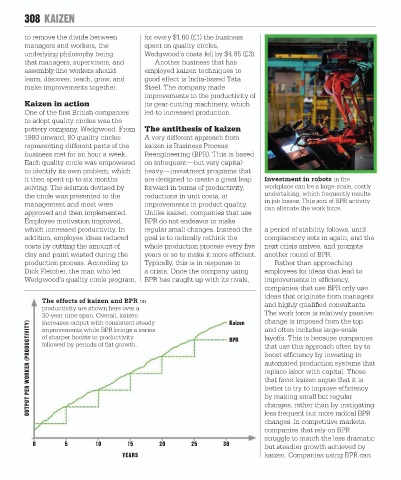
             The effects of kaizen and BPR on                             and highly qualified consultants.
             productivity are shown here over a
             30-year time span. Overall, kaizen                 Kaizen    The work force is relatively passive:
                                                                          change is imposed from the top
         OUTPUT PER WORKER (PRODUCTIVITY)  followed by periods of flat growth.  that use this approach often try to
             increases output with consistent steady
                                                                          and often includes large-scale
             improvements while BPR brings a series
             of sharper boosts to productivity
                                                                          layoffs. This is because companies
                                                                BPR
                                                                          boost efficiency by investing in
                                                                          automated production systems that
                                                                          replace labor with capital. Those
                                                                          that favor kaizen argue that it is
                                                                          better to try to improve efficiency
                                                                          by making small but regular
                                                                          changes, rather than by instigating
                                                                          less frequent but more radical BPR
                                                                          changes. In competitive markets,
                                                                          companies that rely on BPR
                                                                          struggle to match the less dramatic
          0        5       10       15       20       25       30
                                                                          but steadier growth achieved by
                                   YEARS                                  kaizen. Companies using BPR can

