


Page 313 - (DK) The Business Book
P. 313
DELIVERING THE GOODS         311

        See also: Gaining an edge 32–39   ■  Kaizen 302–09   ■  Quality sells 318–23   ■  Planned obsolescence 324–25   ■
        Time-based management 326–27


        market, as it did for the cereal                                  It could be argued that managers
        manufacturer Kellogg’s. Market                                    who do not invest in R&D are
        research showed that there was                                    setting up businesses to fail.
        a desire in the UK for a sweeter                                     Companies such as BMW
        breakfast cereal made from nuts,                                  devote a sizable percentage of their
        which people perceived to be             Innovate or die.         turnover to R&D for motives that
        healthy. To meet this need,             Damon Darlin              extend beyond self-preservation.
        Kellogg’s instructed its R&D     Business editor, The New York Times   Those that launch a new product
        department to design a new                   (1956– )             first can charge premium prices
        breakfast cereal; the result was                                  and will benefit from monopoly profit
        Kellogg’s Crunchy Nut, which                                      until the competition arrives. In
        has become the second most                                        addition, consumers’ brand loyalties
        popular cereal in the UK.                                         are usually established early on.
           There have been some cases                                     Companies that underinvest in R&D,
        in which market research pointed                                  fine to imitate rather than innovate,
        companies in the wrong direction.   work and ignore these findings.    may have problems establishing a
        A prime example can be seen in   The Walkman went on to be one of   strong customer base.
        the creation of Sony’s Walkman.   Sony’s most successful products.   There is more to effective R&D
        This portable audio cassette player                               than spending money on technical
        was invented in 1978 by Nobutoshi   More products, more often     breakthroughs. According to Akio
        Kihara, an audio engineer working   Intense competition resulting from   Morita, converting these advances
        for Sony. According to market    globalization, alongside rapid   into products that provide value and
        research, the Soundabout (the    technological advances, has      benefits for consumers is more
        name for the prototype Walkman)   shortened the selling lives of many   important than the breakthrough
        would never sell because focus   products. To stay in business in   itself. Therefore, it makes sense
        groups declared that listening to   this tough trading environment,   for R&D to be done by a multi-
        music was a social rather than a   companies need to launch new   disciplinary team that includes
        solitary activity. However, Akio   products more regularly; those that   a representative from marketing,
        Morita, Sony’s co-founder, told his   are complacent and fail to innovate    who understands the way the
        R&D department to continue its   will be overtaken by their rivals.    consumer’s mind works. ■

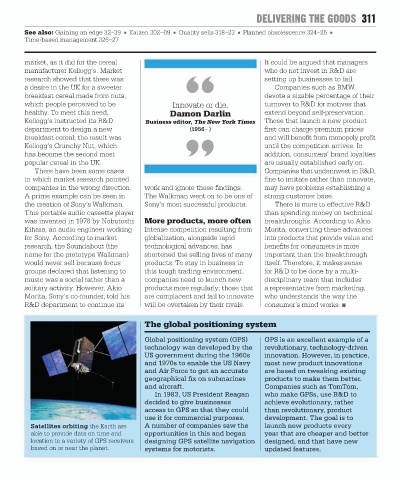
                                         The global positioning system

                                         Global positioning system (GPS)   GPS is an excellent example of a
                                         technology was developed by the   revolutionary, technology-driven
                                         US government during the 1960s   innovation. However, in practice,
                                         and 1970s to enable the US Navy   most new product innovations
                                         and Air Force to get an accurate   are based on tweaking existing
                                         geographical fix on submarines    products to make them better.
                                         and aircraft.                    Companies such as TomTom,
                                            In 1983, US President Reagan   who make GPSs, use R&D to
                                         decided to give businesses       achieve evolutionary, rather
                                         access to GPS so that they could   than revolutionary, product
                                         use it for commercial purposes.    development. The goal is to
          Satellites orbiting the Earth are   A number of companies saw the   launch new products every
          able to provide data on time and   opportunities in this and began   year that are cheaper and better
          location to a variety of GPS receivers   designing GPS satellite navigation   designed, and that have new
          based on or near the planet.   systems for motorists.           updated features.

