


Page 97 - (DK Eyewitness) Travel Guide - Vienna
P. 97
HOFBURG QU AR TER 95
5 Stallburg Hohenberg. No. 6 is the 16th-
century Palffy Palace. On the
Reitschulgasse 2. Map 4 D1 & 5 C3. right of the Prunksaal (see p104)
% Stephansplatz, Herrengasse.
@ 1A, 2A. is the Redoutensaal. Built in
1750–60, it was the venue for
The Stallburg was built in the balls in imperial times. To the
mid-16th century for Emperor left is an extension to the library
Maximilian. This former royal which was built a few years
residence, which was ranged later. Both are by Nikolaus
around a large courtyard, was Pacassi, a favourite architect of
later converted to stables for Maria Theresa.
the Hofburg. The Stallburg
houses the Spanish Riding
School stables (see pp100–101). 7 Dorotheergasse
For much of the 18th century, Map 4 D1 & 5 C4. % Stephansplatz.
the Stallburg was the home @ 1A, 2A, 3A. Jewish Museum:
of the imperial art collection. Tel 5350431. Open 10am–6pm
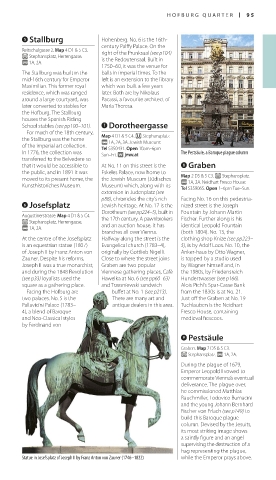
In 1776, the collection was Sun–Fri. ∑ jmw.at The Pestsäule, a Baroque plague column
transferred to the Belvedere so
that it would be accessible to At No. 11 on this street is the 8 Graben
the public, and in 1891 it was Eskeles Palace, now home to Map 2 D5 & 5 C3. % Stephansplatz.
moved to its present home, the the Jewish Museum (Jüdisches @ 1A, 2A. Neidhart Fresco House:
Kunsthistoriches Museum. Museum) which, along with its Tel 5359065. Open 1–6pm Tue–Sun.
extension in Judenplatz (see
p88), chronicles the city’s rich Facing No. 16 on this pedestria-
6 Josefsplatz Jewish heritage. At No. 17 is the nized street is the Joseph
Dorotheum (see pp224–5), built in Fountain by Johann Martin
Augustinerstrasse. Map 4 D1 & 5 C4.
% Stephansplatz, Herrengasse. the 17th century. A pawnbrokers Fischer. Further along is his
@ 1A, 2A. and an auction house, it has identical Leopold Fountain
branches all over Vienna. (both 1804). No. 13, the
At the centre of the Josefsplatz Halfway along the street is the clothing shop Knize (see pp223–
is an equestrian statue (1807) Evangelical church (1783–4), 5), is by Adolf Loos. No. 10, the
of Joseph II by Franz Anton von originally by Gottlieb Nigelli. Anker-haus by Otto Wagner,
Zauner. Despite his reforms, Close to where the street joins is topped by a studio used
Joseph II was a true monarchist, Graben are two popular by Wagner himself and, in
and during the 1848 Revolution Viennese gathering places, Café the 1980s, by Friedensreich
(see p33) loyalists used the Hawelka at No. 6 (see pp60–63) Hundertwasser (see p166).
square as a gathering place. and Trzesniewski sandwich Alois Pichl’s Spar-Casse Bank
Facing the Hofburg are buffet at No. 1 (see p213). from the 1830s is at No. 21.
two palaces. No. 5 is the There are many art and Just off the Graben at No. 19
Pallavicini Palace (1783– antique dealers in this area. Tuchlauben is the Neidhart
4), a blend of Baroque Fresco House, containing
and Neo-Classical styles medieval frescoes.
by Ferdinand von
9 Pestsäule
Graben. Map 2 D5 & 5 C3.
% Stephansplatz. @ 1A, 2A.
During the plague of 1679,
Emperor Leopold I vowed to
commemorate Vienna’s eventual
deliverance. The plague over,
he commissioned Matthias
Rauchmiller, Lodovico Burnacini
and the young Johann Bernhard
Fischer von Erlach (see p149) to
build this Baroque plague
column. Devised by the Jesuits,
its most striking image shows
a saintly figure and an angel
supervising the destruction of a
hag representing the plague,
Statue in Josefsplatz of Joseph II by Franz Anton von Zauner (1746–1822) while the Emperor prays above.
094-095_EW_Vienna.indd 95 03/10/17 11:00 am

