


Page 153 - (DK Eyewitness) Travel Guide - Vienna
P. 153
BEL VEDERE QU AR TER 151
6 Imperial
Hotel
Kärntner Ring 16. Map 4 E2 & 6 D5.
Tel 501100. % Karlsplatz. 7
∑ imperialvienna.com
Along with the Hotel Sacher
(see p142), this is the best-
known of Vienna’s sumptuous
19th-century hotels. You can sip
tea to the sound of a pianist
playing in the background or
stay in the same room Richard
Wagner occupied. Adolf Hitler
made the Imperial Hotel his
headquarters after the
Anschluss (see p38).
7 Schwarzenberg-
platz
Map 4 E2. % Karlsplatz. v D, 71.
At the centre of this grand
square is an equestrian statue
(1867) of Prince Schwarzenberg,
who led the Austrian and allied
armies against Napoleon at the
Battle of Leipzig (1813). The
square comprises huge office
blocks, the Ringstrasse and the
Baroque splendours of the
Schwarzenberg and Belvedere
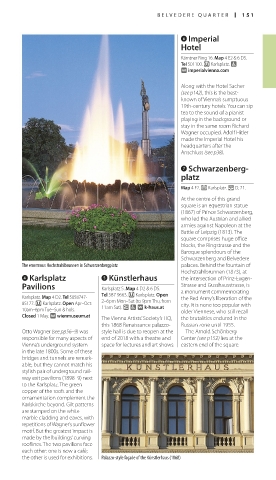
The enormous Hochstrahlbrunnen in Schwarzenbergplatz palaces. Behind the fountain of
Hochstrahlbrunnen (1873), at
4 Karlsplatz 5 Künstlerhaus the intersection of Prinz-Eugen-
Pavilions Karlsplatz 5. Map 4 D2 & 6 D5. Strasse and Gusshausstrasse, is
a monument commemorating
Karlsplatz. Map 4 D2. Tel 5058747- Tel 587 9663. % Karlsplatz. Open the Red Army’s liberation of the
85177. % Karlsplatz. Open Apr–Oct: 2–6pm Mon–Sat (to 9pm Thu, from city. It is none too popular with
10am–6pm Tue–Sun & hols. 11am Sat). ^ 7 ∑ k-haus.at older Viennese, who still recall
Closed 1 May. ∑ wienmuseum.at The Vienna Artists’ Society’s HQ, the brutalities endured in the
this 1868 Renaissance palazzo- Russian zone until 1955.
Otto Wagner (see pp56–9) was style hall is due to reopen at the The Arnold Schönberg
responsible for many aspects of end of 2018 with a theatre and Center (see p152) lies at the
Vienna’s underground system space for lectures and art shows. eastern end of the square.
in the late 1800s. Some of these
bridges and tunnels are remark-
able, but they cannot match his
stylish pair of under ground rail-
way exit pavilions (1898–9) next
to the Karlsplatz. The green
copper of the roofs and the
ornamentation complement the
Karlskirche beyond. Gilt patterns
are stamped on the white
marble cladding and eaves, with
repe ti tions of Wagner’s sunflower
motif. But the greatest impact is
made by the buildings’ curving
rooflines. The two pavilions face
each other: one is now a café;
the other is used for exhibitions. Palazzo-style façade of the Künstlerhaus (1868)
150-151_EW_Vienna.indd 151 03/10/17 11:00 am

