


Page 155 - (DK Eyewitness) Travel Guide - Vienna
P. 155
BEL VEDERE QU AR TER 153
Next door at No. 5 is where
Gustav Mahler (see p41) lived
from 1898 to 1909. No. 5a is
the Gardekirche (1755–63) by
Nikolaus Pacassi (1716–99),
Maria Theresa’s court architect.
It was originally built as the
church of the Imperial Hospital
and since 1897 has been
Vienna’s Polish church. A huge
dome covers the entire interior,
which adds to its spaciousness.
One feature of interest is the
gilt Rococo embellishment
over the side chapels and
between the ribs of the dome.
Just beyond the Belvedere The Botanical Gardens created by Maria Theresa in 1754
palace gates at No. 6a stands
a Baroque mansion. The century, they remain a centre style after the Turkish siege
forecourt at No. 8 has formed for the study of plant sciences of 1683 by the architect and
part of the Hoch schule für as part of the University of theatre designer Lodovico
Musik since 1988. Vienna’s Institute of Botany Burnacini (1636–1707) and
At No. 10, behind splendid and contain more than 9,000 others. Known at the time
wrought-iron gates, stands the plant species. Of equal interest as the Favorita, it became
Salesianerinnenkirche of 1717– to amateurs, the gardens offer a favourite residence of
30. Its Baroque façade is a quiet spot to sit and relax emperors Leopold I, Joseph I
flanked by monastic buildings after sightseeing. and Karl VI. In 1746 Maria
in the same style. The upper The main entrance to the Theresa, who had moved
storey has scrolled projections Botanical Gardens is on the into Schönbrunn (see pp174–9),
that serve as the base for corner of Prätoriusgasse and her summer palace, handed
statues. Like the Gardekirche, Mechelgasse. Other entrances it over to the Jesuits. They
this church is domed, its are on Jacquingasse, and via established a college here
design partly attributed to a small gate at the rear of the for the education of children
Joseph Emanuel Fischer von Upper Belvedere, which leads from less well-off aristocratic
Erlach (see p149). Apart from to the Alpine Garden and the families – the sons of these
the pulpit, the interior is of Botanical Gardens. families were trained to
little interest. be officials.
At No. 27, the present-day Today, the Theresianum is
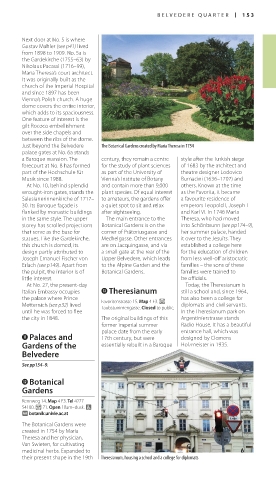
Italian Embassy occupies e Theresianum still a school and, since 1964,
the palace where Prince Favoritenstrasse 15. Map 4 E3. % has also been a college for
Metternich (see p32) lived Taubstummengasse. Closed to public. diplomats and civil servants.
until he was forced to flee In the Theresianum park on
the city in 1848. The original buildings of this Argentinierstrasse stands
former imperial summer Radio House. It has a beautiful
palace date from the early entrance hall, which was
q Palaces and 17th century, but were designed by Clemens
Gardens of the essentially rebuilt in a Baroque Holzmeister in 1935.
Belvedere
See pp154–9.
w Botanical
Gardens
Rennweg 14. Map 4 F3. Tel 4277
54100. v 71. Open 10am–dusk. 7
∑ botanik.univie.ac.at
The Botanical Gardens were
created in 1754 by Maria
Theresa and her physician,
Van Swieten, for cultivating
medicinal herbs. Expanded to
their present shape in the 19th Theresianum, housing a school and a college for diplomats
152-153_EW_Vienna.indd 153 03/10/17 11:00 am

