


Page 24 - (DK Eyewitness) Travel Guide - Vienna
P. 24
22 INTRODUCING VIENNA THE HIST OR Y OF VIENNA 23
Early Vienna Marcus Aurelius
This great Roman emperor and Where to See
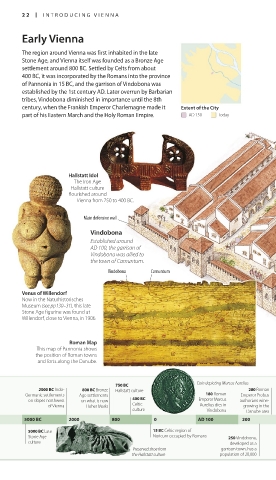
The region around Vienna was first inhabited in the late philosopher came to Carnuntum Early Vienna
to fight the Germanic tribes; he
Stone Age, and Vienna itself was founded as a Bronze Age died in Vindobona in AD 180. Many of the Roman walls and
settlement around 800 BC. Settled by Celts from about ditches have left their mark on the
400 BC, it was incorporated by the Romans into the province layout of Vienna, but excavations
have not been numerous. The
of Pannonia in 15 BC, and the garrison of Vindobona was most impressive are at Hoher
established by the 1st century AD. Later overrun by Barbarian Markt (see p86), at No. 10 Am Hof
tribes, Vindobona diminished in importance until the 8th (p89), and in the Michaelerplatz
century, when the Frankish Emperor Charlemagne made it Extent of the City (p94). The most extensive remains
are not in Vienna itself but at
part of his Eastern March and the Holy Roman Empire. AD 150 Today Carnuntum, about 25 miles
(40 km) to the east, where
two amphitheatres and other
ruins survive.
Gold Jewellery
The Romans were first attracted to
the region around Vindobona for its
valuable resources, among them gold.
Hallstatt Idol
The Iron Age
Hallstatt culture
flourished around
Vienna from 750 to 400 BC.
Main defensive wall
Vindobona Stables
Established around The Hoher Markt, in the very
AD 100, the garrison of heart of Vienna, is the site of
Vindobona was allied to excavations of the Roman
the town of Carnuntum. garrison of Vindobona.
Vindobona Carnuntum
Venus of Willendorf Soldiers’
Now in the Naturhistorisches quarters
Museum (see pp130–31), this late
Stone Age figurine was found at
Willendorf, close to Vienna, in 1906.
Soldier’s Tomb
Roman Map
This map of Pannonia shows This tomb, excavated This gorgon’s head, a Roman
the position of Roman towns at Carnuntum, dates relief of the mythical Medusa,
from around the
was found at Hoher Markt.
and forts along the Danube.
1st century AD.
750 BC Coin depicting Marcus Aurelius
2000 BC Indo- 800 BC Bronze Hallstatt culture 280 Roman 280 Roman 395 First Barbarian invasions
Germanic settlements Age settlements 180 Roman Emperor Probus Emperor Probus approach Vindobona 500–650 Repeated invasions
on slopes northwest on what is now 400 BC Emperor Marcus authorizes wine-authorizes wine- 405 Romans withdraw by Langobards, Goths, Avars
of Vienna Hoher Markt Celtic Aurelius dies in growing in the growing in the and Slav tribes
culture Vindobona Danube areaDanube area from Vindobona
5000 BC 2000 800 0 AD 100 200 300300 400 500 600 700 800
5000 BC Late 15 BC Celtic region of 883 First mention of
Stone Age Noricum occupied by Romans 250 Vindobona, 433 Vindobona Wenia (Vienna) on the
culture developed as a destroyed by Huns borders of the Eastern
Preserved shoe from garrison town, has a Barbarian March founded by
the Hallstatt culture population of 20,000 horseman Charlemagne
022-023_EW_Vienna.indd 22 03/10/17 10:59 am 022-023_EW_Vienna.indd 23 03/10/17 10:59 am
Eyewitness Travel LAYERS PRINTED:
Starsight history template “UK” LAYER
(Source v1.2)
Date 7th January 2013
Size 125mm x 217mm

