


Page 25 - (DK Eyewitness) Travel Guide - Vienna
P. 25
THE HIST OR Y OF VIENNA 23
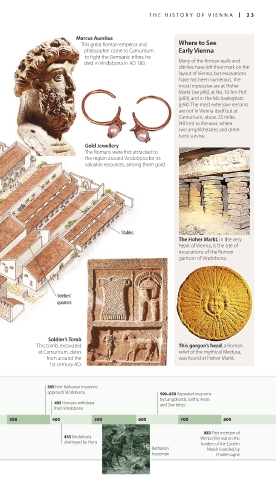
Marcus Aurelius
This great Roman emperor and Where to See
philosopher came to Carnuntum Early Vienna
to fight the Germanic tribes; he
died in Vindobona in AD 180. Many of the Roman walls and
ditches have left their mark on the
layout of Vienna, but excavations
have not been numerous. The
most impressive are at Hoher
Markt (see p86), at No. 10 Am Hof
(p89), and in the Michaelerplatz
(p94). The most extensive remains
are not in Vienna itself but at
Carnuntum, about 25 miles
(40 km) to the east, where
two amphitheatres and other
ruins survive.
Gold Jewellery
The Romans were first attracted to
the region around Vindobona for its
valuable resources, among them gold.
Stables
The Hoher Markt, in the very
heart of Vienna, is the site of
excavations of the Roman
garrison of Vindobona.
Soldiers’
quarters
Soldier’s Tomb
This tomb, excavated This gorgon’s head, a Roman
at Carnuntum, dates relief of the mythical Medusa,
from around the was found at Hoher Markt.
1st century AD.
395 First Barbarian invasions
280 Roman
Emperor Probus approach Vindobona 500–650 Repeated invasions
authorizes wine- 405 Romans withdraw by Langobards, Goths, Avars
growing in the from Vindobona and Slav tribes
Danube area
300 400 500 600 700 800
883 First mention of
433 Vindobona Wenia (Vienna) on the
destroyed by Huns borders of the Eastern
Barbarian March founded by
horseman Charlemagne
022-023_EW_Vienna.indd 23 03/10/17 10:59 am

