


Page 29 - (DK Eyewitness) Travel Guide - Vienna
P. 29
THE HIST OR Y OF VIENNA 27
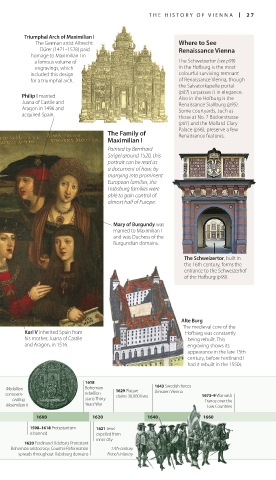
Triumphal Arch of Maximilian I
The German artist Albrecht Where to See
Dürer (1471–1528) paid Renaissance Vienna
homage to Maximilian I in
a famous volume of The Schweizertor (see p99)
engravings, which in the Hofburg is the most
included this design colourful surviving remnant
for a triumphal arch. of Renaissance Vienna, though
the Salvatorkapelle portal
(p87) surpasses it in elegance.
Philip I married Also in the Hofburg is the
Juana of Castile and Renaissance Stallburg (p95).
Aragon in 1496 and Some courtyards, such as
acquired Spain. those at No. 7 Bäckerstrasse
(p81) and the Mollard-Clary
Palace (p96), preserve a few
The Family of Renaissance features.
Maximilian I
Painted by Bernhard
Strigel around 1520, this
portrait can be read as
a document of how, by
marrying into prominent
European families, the
Habsburg families were
able to gain control of
almost half of Europe.
Mary of Burgundy was
married to Maximilian I
and was Duchess of the
Burgundian domains.
The Schweizertor, built in
the 16th century, forms the
entrance to the Schweizerhof
of the Hofburg (p99).
Alte Burg
The medieval core of the
Karl V inherited Spain from Hofburg was constantly
his mother, Juana of Castile being rebuilt. This
and Aragon, in 1516. engraving shows its
appearance in the late 15th
century, before Ferdinand I
had it rebuilt in the 1550s.
1618
1571 Protestant Medallion Bohemian 1643 Swedish forces
Maximilian II allows commem- rebellion 1629 Plague threaten Vienna
religious freedom; orating starts Thirty claims 30,000 lives 1673–9 War with
80% of city is Maximilian II Years’ War France over the
Protestant Low Countries
1580 1600 1620 1640 1660
1598–1618 Protestantism 1621 Jews
is banned expelled from
inner city
1620 Ferdinand II defeats Protestant
Bohemian aristocracy; Counter-Reformation 17th-century
spreads throughout Habsburg domains French infantry
026-027_EW_Vienna.indd 27 03/10/17 10:59 am

