


Page 83 - (DK Eyewitness) Travel Guide - Vienna
P. 83
STEPHANSDOM QU AR TER 81
e Heiligen and stables, the only surviving
kreuzerhof example in Vienna. Two other
houses of Renaissance origin
Schönlaterngasse 5. Map 2 E5 & 6 E3. are located at Nos. 12 and 14.
Tel 5125896. % Schwedenplatz.
Open 6am–9pm Mon–Sat. 7
Bernhardskapelle: Open on request
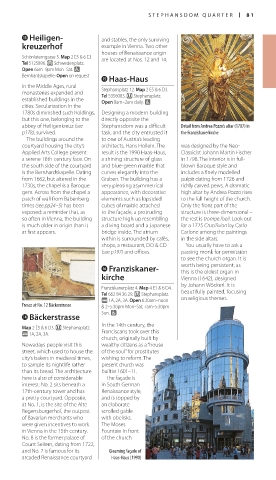
t HaasHaus
In the Middle Ages, rural Stephansplatz 12. Map 2 E5 & 6 D3.
monasteries expanded and Tel 5356083. % Stephansplatz.
established buildings in the Open 8am–2am daily. 7
cities. Secularization in the
1780s diminished such holdings, Designing a modern building
but this one, belonging to the directly opposite the
abbey of Heiligenkreuz (see Stephansdom was a difficult Detail from Andrea Pozzo’s altar (1707) in
p178), survived. task, and the city entrusted it the Franziskanerkirche
The buildings around the to one of Austria’s leading
courtyard housing the city’s architects, Hans Hollein. The was designed by the Neo-
Applied Arts College present result is the 1990 Haas-Haus, Classicist Johann Martin Fischer
a serene 18th-century face. On a shining structure of glass in 1798. The interior is in full-
the south side of the courtyard and blue-green marble that blown Baroque style and
is the Bernhardskapelle. Dating curves elegantly into the includes a finely modelled
from 1662, but altered in the Graben. The building has a pulpit dating from 1726 and
1730s, the chapel is a Baroque very pleasing asymmetrical richly carved pews. A dramatic
gem. Across from the chapel a appearance, with decorative high altar by Andrea Pozzo rises
patch of wall from Babenberg elements such as lopsided to the full height of the church.
times (see pp24–5) has been cubes of marble attached Only the front part of the
exposed: a reminder that, as to the façade, a protruding structure is three-dimensional –
so often in Vienna, the building structure high up resembling the rest is trompe l’oeil. Look out
is much older in origin than it a diving board and a Japanese for a 1725 Crucifixion by Carlo
at first appears. bridge inside. The atrium Carlone among the paintings
within is surrounded by cafés, in the side altars.
shops, a restaurant, DO & CO You usually have to ask a
(see p197) and offices. passing monk for permission
to see the church organ. It is
y Franziskaner worth being persistent, as
this is the oldest organ in
kirche Vienna (1642), designed
by Johann Wöckerl. It is
Franziskanerplatz 4. Map 4 E1 & 6 D4.
Tel 662 84 36 29. % Stephansplatz. beautifully painted, focusing
@ 1A, 2A, 3A. Open 6:30am–noon on religious themes.
Fresco at No. 12 Bäckerstrasse & 2–5:30pm Mon–Sat, 7am–5:30pm
r Bäckerstrasse Sun. 7
In the 14th century, the
Map 2 E5 & 6 D3. % Stephansplatz.
@ 1A, 2A, 3A. Franciscans took over this
church, originally built by
Nowadays people visit this wealthy citizens as a “house
street, which used to house the of the soul” for prostitutes
city’s bakers in medieval times, wishing to reform. The
to sample its nightlife rather present church was
than its bread. The architecture built in 1601–11.
here is also of considerable The façade is
interest: No. 2 sits beneath a in South German
17th-century tower and has Renaissance style,
a pretty courtyard. Opposite, and is topped by
at No. 1, is the site of the Alte an elaborate
Regensburgerhof, the outpost scrolled gable
of Bavarian merchants who with obelisks.
were given incentives to work The Moses
in Vienna in the 15th century. Fountain in front
No. 8 is the former palace of of the church
Count Seilern, dating from 1722,
and No. 7 is famous for its Gleaming façade of
arcaded Renaissance courtyard Haas-Haus (1990)
080-081_EW_Vienna.indd 81 03/10/17 11:00 am

