


Page 85 - (DK Eyewitness) Travel Guide - Vienna
P. 85
STEPHANSDOM QU AR TER 83
Griechenbeisl (see p210) is its
best-known landmark. On
its façade is a woodcarving of
a bagpiper known as Der liebe
Augustin (Dear Augustin).
Rumour has it that during the
1679 plague, this bagpiper
slumped drunk into the gutter
one night and, taken for dead,
was put in the plague pit. He
woke, attracted attention by
playing his pipes and was
rescued. Miraculously, he
did not catch the plague.
Next to the Griechenbeisl
is the beautiful Neo-Byzantine
Griechische Kirche (Greek
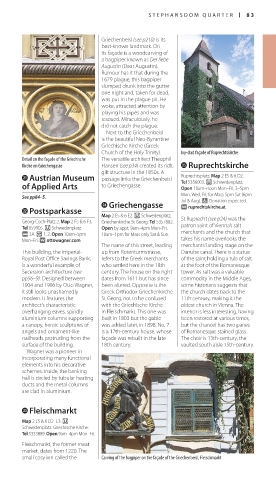
Church of the Holy Trinity). Ivy-clad façade of Ruprechtskirche
Detail on the façade of the Griech ische The versatile architect Theophil
Kirche on Griechengasse Hansen (see p34) created its rich, g Ruprechtskirche
gilt structure in the 1850s. A
a Austrian Museum passage links the Griechenbeisl Ruprechtsplatz. Map 2 E5 & 6 D2.
Tel 5356003. % Schwedenplatz.
of Applied Arts to Griechengasse. Open 10am–noon Mon–Fri, 3–5pm
Mon, Wed, Fri; for Mass 5pm Sat (6pm
See pp84–5. Jul & Aug). 7 Donation expected.
f Griechengasse ∑ ruprechtskirche.at
s Postsparkasse
Map 2 E5 & 6 E2. % Schwedenplatz.
Georg-Coch-Platz 2. Map 2 F5 & 6 F3. Griechenkirche St Georg: Tel 5357882. St Ruprecht (see p24) was the
Tel 059905. % Schwedenplatz. Open by appt, 9am–4pm Mon–Fri, patron saint of Vienna’s salt
@ 3A. v 1, 2. Open 10am–5pm 10am–1pm for Mass only Sat & Sun. merchants and the church that
Mon–Fri. ∑ ottowagner.com takes his name overlooks the
The name of this street, leading merchants’ landing stage on the
This building, the Imperial- up from Rotenturmstrasse, Danube canal. There is a statue
Royal Post Office Savings Bank, refers to the Greek merchants of the saint holding a tub of salt
is a wonderful example of who settled here in the 18th at the foot of the Romanesque
Secession architecture (see century. The house on the right tower. As salt was a valuable
pp56–9). Designed between dates from 1611 but has since commodity in the Middle Ages,
1904 and 1906 by Otto Wagner, been altered. Opposite is the some historians suggests that
it still looks unashamedly Greek Orthodox Griechenkirche the church dates back to the
modern. It features the St Georg, not to be confused 11th century, making it the
architect’s characteristic with the Griechische Kirche oldest church in Vienna. The
overhanging eaves, spindly in Fleischmarkt. This one was interior is less interesting, having
aluminium columns supporting built in 1803 but the gable been restored at various times,
a canopy, heroic sculptures of was added later, in 1898. No. 7 but the chancel has two panes
angels and ornament-like is a 17th-century house. whose of Romanesque stained glass.
nailheads protruding from the façade was rebuilt in the late The choir is 13th-century, the
surface of the building. 18th century. vaulted south aisle 15th-century.
Wagner was a pioneer in
incorporating many functional
elements into his decorative
schemes. Inside, the banking
hall is circled by tubular heating
ducts and the metal columns
are clad in aluminium.
d Fleischmarkt
Map 2 E5 & 6 D2–E3. %
Schwedenplatz. Griechische Kirche:
Tel 5333889. Open 9am–4pm Mon–Fri.
Fleischmarkt, the former meat
market, dates from 1220. The
small cosy inn called the Carving of the bagpiper on the façade of the Griechenbeisl, Fleischmarkt
082-083_EW_Vienna.indd 83 03/10/17 11:12 am

