


Page 96 - (DK Eyewitness) Travel Guide - Vienna
P. 96
94 VIENNA AREA B Y AREA HOFBURG QU AR TER 95
1 Michaelerplatz 5 Stallburg Hohenberg. No. 6 is the 16th-
Adolf Loos
Map 5 C3. % Herrengasse. @ 1A, 2A. Reitschulgasse 2. Map 4 D1 & 5 C3. century Palffy Palace. On the
Unlike his contemporary Otto % Stephansplatz, Herrengasse. right of the Prunksaal (see p104)
Michaelerplatz faces the Wagner (see p59), Adolf Loos @ 1A, 2A. is the Redoutensaal. Built in
impressive Neo-Baroque (1870–1933) loathed ornament 1750–60, it was the venue for
Michaelertor, which leads to for its own sake. Instead, The Stallburg was built in the balls in imperial times. To the
the Hofburg’s inner courtyard. he used smooth lines and mid-16th century for Emperor left is an extension to the library
On both sides of the doorway exquisite interior decoration; Maximilian. This former royal which was built a few years
are 19th-century wall fountains, his buildings’ lack of “eyebrows” residence, which was ranged later. Both are by Nikolaus
designed by Rudolf Weyer. (the window hoods on around a large courtyard, was Pacassi, a favourite architect of
Opposite are the Michaeler- many of Vienna’s buildings) later converted to stables for Maria Theresa.
kirche and Looshaus. On one scandalized Viennese society. the Hofburg. The Stallburg
side of Michaelerplatz is the Surviving interiors by Loos houses the Spanish Riding
domed Michaelertrakt, an include Knize (see p95), the School stables (see pp100–101). 7 Dorotheergasse
extravagant wing of the American Bar (see p107) and For much of the 18th century, Map 4 D1 & 5 C4. % Stephansplatz.
imperial palace. An old design the Café Museum (see p139). the Stallburg was the home @ 1A, 2A, 3A. Jewish Museum:
by Joseph Emanuel Fischer of the imperial art collection. Tel 5350431. Open 10am–6pm
von Erlach (see p149) was used In 1776, the collection was Sun–Fri. ∑ jmw.at The Pestsäule, a Baroque plague column
as the basis for a new design by again. Today it’s hard to is at No. 11 Kohlmarkt. It has transferred to the Belvedere so
Ferdinand Kirschner (1821–96). It understand why: the outside is a handsome courtyard and that it would be accessible to At No. 11 on this street is the 8 Graben
was finished in 1893, complete unexceptional but the inside coach house, with a fine view the public, and in 1891 it was Eskeles Palace, now home to Map 2 D5 & 5 C3. % Stephansplatz.
with gilt-tasselled cupolas and is a lesson in stylish elegance. of the older parts of the moved to its present home, the the Jewish Museum (Jüdisches @ 1A, 2A. Neidhart Fresco House:
statuary representing Austria’s Michaelerkirche. The buildings Kunsthistoriches Museum. Museum) which, along with its Tel 5359065. Open 1–6pm Tue–Sun.
land and sea power. around the courtyard were extension in Judenplatz (see
At the centre is an excavation 3 Grosses und erected in about 1720. The p88), chronicles the city’s rich Facing No. 16 on this pedestria-
site that reveals remains of a Kleines composer Joseph Haydn (see 6 Josefsplatz Jewish heritage. At No. 17 is the nized street is the Joseph
Roman encampment, as well as Michaelerhaus p40) is said to have lived in an Augustinerstrasse. Map 4 D1 & 5 C4. Dorotheum (see pp224–5), built in Fountain by Johann Martin
some medieval foundations. unheated attic here in 1749. % Stephansplatz, Herrengasse. the 17th century. A pawnbrokers Fischer. Further along is his
Kohlmarkt 11 & Michaelerplatz 6. @ 1A, 2A. and an auction house, it has identical Leopold Fountain
Map 2 D5 & 5 C3. % Herrengasse. branches all over Vienna. (both 1804). No. 13, the
2 Looshaus @ 1A, 2A. Closed to the public. 4 Michaelerkirche At the centre of the Josefsplatz Halfway along the street is the clothing shop Knize (see pp223–
is an equestrian statue (1807) Evangelical church (1783–4), 5), is by Adolf Loos. No. 10, the
Michaelerplatz 3. Map 2 D5 & At No. 6 Michaelerplatz Michaelerplatz 1. Map 2 D5 & 5 C3. of Joseph II by Franz Anton von originally by Gottlieb Nigelli. Anker-haus by Otto Wagner,
5 C3. Tel 517 00900. Tel 5338000. % Herrengasse,
% Herrengasse. @ 1A, 2A. a footpath leads to Stephansplatz. @ 1A, 2A. Zauner. Despite his reforms, Close to where the street joins is topped by a studio used
Open 9am–3pm Mon–Wed the Baroque Kleines Open 7am–10pm Mon–Sat, 8am– Joseph II was a true monarchist, Graben are two popular by Wagner himself and, in
& Fri, 9am–5:30pm Thu. 7 Michaelerhaus (1735). 10pm Sun & hols. & 7 8 Tours and during the 1848 Revolution Viennese gathering places, Café the 1980s, by Friedensreich
Look out for a vivid of the crypt: 11am & 1pm Mon–Sat. (see p33) loyalists used the Hawelka at No. 6 (see pp60–63) Hundertwasser (see p166).
Erected opposite the painted relief of Christ square as a gathering place. and Trzesniewski sandwich Alois Pichl’s Spar-Casse Bank
Michaelertor in 1910– on the Mount of Olives The Michaelerkirche was once Facing the Hofburg are buffet at No. 1 (see p213). from the 1830s is at No. 21.
12, and designed by with a crucifixion in the parish church of the court. two palaces. No. 5 is the There are many art and Just off the Graben at No. 19
Adolf Loos, this building the background (1494) Its earliest parts were built in Pallavicini Palace (1783– antique dealers in this area. Tuchlauben is the Neidhart
so outraged Franz on the side of the the 13th century; according to 4), a blend of Baroque Fresco House, containing
Ferdinand (see p168) Michaeler kirche. The legend the church was built in and Neo-Classical styles medieval frescoes.
that he declared he Baroque façade 1221 but its present form dates by Ferdinand von
would never use of the Grosses from 1792. Its porch is topped
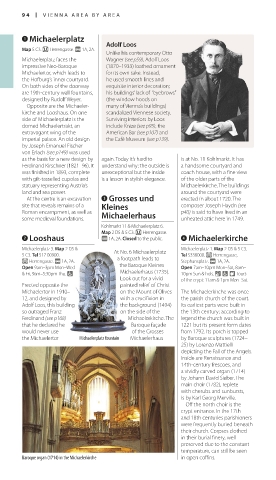
the Michaelertor Michaelerplatz fountain Michaelerhaus by Baroque sculptures (1724– 9 Pestsäule
25) by Lorenzo Mattielli Graben. Map 2 D5 & 5 C3.
depicting the Fall of the Angels. % Stephansplatz. @ 1A, 2A.
Inside are Renaissance and
14th-century frescoes, and During the plague of 1679,
a vividly carved organ (1714) Emperor Leopold I vowed to
by Johann David Sieber. The commemorate Vienna’s eventual
main choir (1782), replete deliverance. The plague over,
with cherubs and sunbursts, he commissioned Matthias
is by Karl Georg Merville. Rauchmiller, Lodovico Burnacini
Off the north choir is the and the young Johann Bernhard
crypt entrance. In the 17th Fischer von Erlach (see p149) to
and 18th centuries parishioners build this Baroque plague
were frequently buried beneath column. Devised by the Jesuits,
their church. Corpses clothed its most striking image shows
in their burial finery, well a saintly figure and an angel
preserved due to the constant supervising the destruction of a
temperature, can still be seen hag representing the plague,
Baroque organ (1714) in the Michaelerkirche in open coffins. Statue in Josefsplatz of Joseph II by Franz Anton von Zauner (1746–1822) while the Emperor prays above.
094-095_EW_Vienna.indd 94 03/10/17 11:00 am 094-095_EW_Vienna.indd 95 03/10/17 11:00 am
Eyewitness Travel LAYERS PRINTED:
Catalogue template “UK” LAYER
(Source v2.4)
Date 25th April 2013
Size 125mm x 217mm

