


Page 136 - (DK Eyewitness) Travel Guide - Estonia Latvia & Lithuania
P. 136
134 INTRODUCING LA T VIA
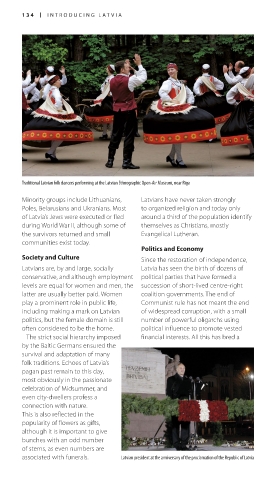
Traditional Latvian folk dancers performing at the Latvian Ethnographic Open-Air Museum, near Rīga
Minority groups include Lithuanians, Latvians have never taken strongly
Poles, Belarusians and Ukranians. Most to organized religion and today only
of Latvia’s Jews were executed or fled around a third of the population identify
during World War II, although some of themselves as Christians, mostly
the survivors returned and small Evangelical Lutheran.
communities exist today.
Politics and Economy
Society and Culture Since the restoration of independence,
Latvians are, by and large, socially Latvia has seen the birth of dozens of
conservative, and although employ ment political parties that have formed a
levels are equal for women and men, the succession of short-lived centre-right
latter are usually better paid. Women coalition governments. The end of
play a prominent role in public life, Communist rule has not meant the end
including making a mark on Latvian of widespread corruption, with a small
politics, but the female domain is still num ber of powerful oligarchs using
often considered to be the home. political influence to promote vested
The strict social hierarchy imposed financial interests. All this has bred a
by the Baltic Germans ensured the
survival and adaptation of many
folk traditions. Echoes of Latvia’s
pagan past remain to this day,
most obviously in the passionate
celebra tion of Midsummer, and
even city-dwellers profess a
connection with nature.
This is also reflected in the
popularity of flowers as gifts,
although it is important to give
bunches with an odd number
of stems, as even num bers are
associated with funerals. Latvian president at the anniversary of the proclamation of the Republic of Latvia
132-135.indd 134 15/02/17 10:20 am

