


Page 22 - (DK Eyewitness) Travel Guide - Estonia Latvia & Lithuania
P. 22
20       INTRODUCING  EST ONIA ,  LA T VIA  AND  LITHU ANIA


        Architectural Styles
        Ever since the wooden fortifications of the Baltic tribes were
        replaced by stone castles in the 13th and 14th centuries,
        foreign influences have domi nated the architecture of
        Estonia, Latvia and Lithuania. Today, the Baltic capitals are
        archi tectural treasure troves, with Tallinn particularly noted
        for its medieval buildings, Vilnius for its Italian Baroque and
        Rīga for its Art Nouveau. The Soviet era saw the building of
        inexpensive mass housing. Since independence private
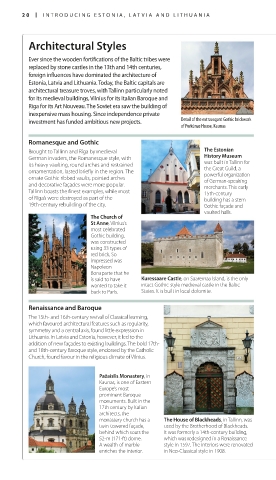
                                               Detail of the extravagant Gothic brickwork
        investment has funded ambitious new projects.
                                               of Perkūnas House, Kaunas
        Romanesque and Gothic
        Brought to Tallinn and Rīga by medieval      The Estonian
        German invaders, the Romanesque style, with   History Museum
        its heavy vaulting, round arches and restrained   was built in Tallinn for
                                                     the Great Guild, a
        ornamentation, lasted briefly in the region. The   powerful organization
        ornate Gothic ribbed vaults, pointed arches
                                                     of German-speaking
        and decorative façades were more popular.    merchants. This early
        Tallinn boasts the finest examples, while most
                                                     15th-century
        of Rīga’s were destroyed as part of the      building has a stern
        19th-century rebuilding of the city.         Gothic façade and
                                                     vaulted halls.
                        The Church of
                        St Anne, Vilnius’s
                        most celebrated
                        Gothic building,
                        was constructed
                        using 33 types of
                        red brick. So
                        impressed was
                        Napoleon
                        Bonaparte that he
                        is said to have   Kuressaare Castle, on Saaremaa Island, is the only
                        wanted to take it   intact Gothic-style medieval castle in the Baltic
                        back to Paris.  States. It is built in local dolomite.
        Renaissance and Baroque
        The 15th- and 16th-century revival of Classical learning,
        which favoured architectural features such as regularity,
        symmetry and a central axis, found little expression in
        Lithuania. In Latvia and Estonia, however, it led to the
        addition of new façades to existing buildings. The bold 17th-
        and 18th-century Baroque style, endorsed by the Catholic
        Church, found favour in the religious climate of Vilnius.

                           Pažaislis Monastery, in
                           Kaunas, is one of Eastern
                           Europe’s most
                           prominent Baroque
                           monuments. Built in the
                           17th century by Italian
                           architects, the
                           monastery church has a   The House of Blackheads, in Tallinn, was
                           twin-towered façade,   used by the Brotherhood of Blackheads.
                           behind which soars the   It was formerly a 14th-century building,
                           52-m (171-ft) dome.    which was redesigned in a Renaissance
                           A wealth of marble   style in 1597. The interiors were reno vated
                           enriches the interior.  in Neo-Classical style in 1908.

