


Page 23 - (DK Eyewitness) Travel Guide - Estonia Latvia & Lithuania
P. 23
A  POR TRAIT  OF  EST ONIA ,  LA T VIA  AND  LITHU ANIA       21


       Neo-Classical and Historicist
       The Neo-Classical style arrived in the Baltic States as late as
       the 1780s. The style had a strong influence on Tartu, as well
       as some of the finest manor houses throughout Estonia.
       However, most examples today are found in Tallinn, often as
       façades on earlier buildings; some Latvian and Lithuanian
       palaces also exhibit the style. Around 1820, the Historicist
       movement became popular, drawing inspiration from various
       styles including Gothic, Renaissance and Neo-Baroque.

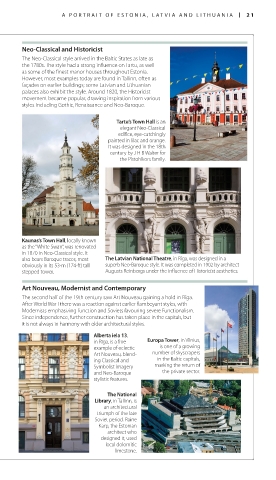
                               Tartu’s Town Hall is an
                                elegant Neo-Classical
                               edi fice, eye-catchingly
                             pain ted in lilac and orange.
                             It was designed in the 18th
                             century by J H B Walter for
                                the Pistohlkors family.


       Kaunas’s Town Hall, locally known
       as the “White Swan”, was reno vated
       in 1870 in Neo-Classical style. It
       also bears Baroque traces, most   The Latvian National Theatre, in Rīga, was designed in a
       obviously in its 53-m (174-ft) tall   superb Neo-Baroque style. It was completed in 1902 by architect
       stepped tower.       Augusts Reinbergs under the influence of Historicist aesthetics.

       Art Nouveau, Modernist and Contemporary
       The second half of the 19th century saw Art Nouveau gaining a hold in Rīga.
       After World War I there was a reaction against earlier flamboyant styles, with
       Modernists emphasizing function and Soviets favouring severe Functionalism.
       Since independence, further construction has taken place in the capitals, but
       it is not always in harmony with older architectural styles.
                         Alberta iela 13,
                         in Rīga, is a fine   Europa Tower, in Vilnius,
                         example of eclectic   is one of a growing
                         Art Nouveau, blend-  number of skyscrapers
                         ing Classical and   in the Baltic capitals,
                         Symbolist imagery   marking the return of
                         and Neo-Baroque   the private sector.
                         stylis tic features.

                             The National
                         Library, in Tallinn, is
                            an architectural
                          triumph of the late
                         Soviet period. Raine
                          Karp, the Estonian
                             architect who
                           designed it, used
                            local dolomitic
                               limestone.

