


Page 26 - (DK Eyewitness) Travel Guide - Estonia Latvia & Lithuania
P. 26
24       INTRODUCING  EST ONIA ,  LA T VIA  AND  LITHU ANIA


        Religion
        Although the Baltic lands were officially Christian by the end
        of the 14th century, pagan beliefs persisted and mingled
        with the new religion. Protestantism left its mark in the
        16th century, but Lithuania soon returned to the Catholic
        fold. Today, it is the only Baltic State where the church plays
        a major public role – in Estonia and Latvia, the surge in
        religious participation after independence in 1991 proved
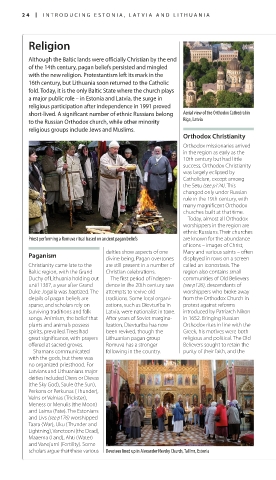
        short-lived. A significant number of ethnic Russians belong   Aerial view of the Orthodox Cathedral in
                                                Rīga, Latvia
        to the Russian Orthodox church, while other minority
        religious groups include Jews and Muslims.
                                                Orthodox Christianity
                                                Orthodox missionaries arrived
                                                in the region as early as the
                                                10th century but had little
                                                success. Orthodox Christianity
                                                was largely eclipsed by
                                                Catholicism, except among
                                                the Setu (see p124). This
                                                changed only under Russian
                                                rule in the 19th century, with
                                                many magnificent Orthodox
                                                churches built at that time.
                                                  Today, almost all Orthodox
                                                worshippers in the region are
                                                ethnic Russians. Their churches
        Priest performing a Romuva ritual based on ancient pagan beliefs  are known for the abundance
                                                of icons – images of Christ,
                            deities show aspects of one   Mary and various saints – often
        Paganism
                            divine being. Pagan over tones   displayed in rows on a screen
        Christianity came late to the   are still present in a number of   called an iconostasis. The
        Baltic region, with the Grand   Christian celebrations.  region also contains small
        Duchy of Lithuania holding out     The first period of indepen-  communities of Old Believers
        until 1387, a year after Grand   dence in the 20th century saw   (see p126), descendants of
        Duke Jogaila was baptized. The   attempts to revive old   worshippers who broke away
        details of pagan beliefs are   traditions. Some local organi-  from the Orthodox Church in
        sparse, and scholars rely on   zations, such as Dievturība in   protest against reforms
        surviving traditions and folk   Latvia, were nationalist in tone.   introduced by Patriarch Nikon
        songs. Animism, the belief that   After years of Soviet margina-  in 1652. Bringing Russian
        plants and animals possess   lization, Dievturība has now   Orthodox rites in line with the
        spirits, prevailed. Trees had   been revived, though the   Greek, his motives were both
        great significance, with prayers   Lithuanian pagan group   religious and political. The Old
        offered at sacred groves.  Romuva has a stronger   Believers sought to retain the
         Shamans communicated   following in the country.  purity of their faith, and the
        with the gods, but there was
        no organized priesthood. For
        Latvians and Lithuanians major
        deities included Dievs or Dievas
        (the Sky God), Saule (the Sun),
        Pērkons or Perkūnas (Thunder),
        Velns or Velnias (Trickster),
        Mēness or Menulis (the Moon)
        and Laima (Fate). The Estonians
        and Livs (see p176) worshipped
        Taara (War), Uku (Thunder and
        Lightning), Vanetooni (the Dead),
        Maaema (Land), Ahti (Water)
        and Vanejumi (Fertility). Some
        scholars argue that these various   Devotees lined up in Alexander Nevsky Church, Tallinn, Estonia

