


Page 27 - (DK Eyewitness) Travel Guide - Estonia Latvia & Lithuania
P. 27
A  POR TRAIT  OF  EST ONIA ,  LA T VIA  AND  LITHU ANIA       25


       result was the Russian term
       raksol (schism) and their
       subsequent perse cution. Many
       Old Believers fled from Russia,
       and today the main
       communities in the Baltic
       States are around Lake Peipsi
       (see p127) in Estonia and in the
       Latgale region of Latvia.
       Differences in rites include
       making the sign of the cross
       with two fingers (the Orthodox
       church now uses three) and
       changes to the wording of the
       Creed. Old Believers regard
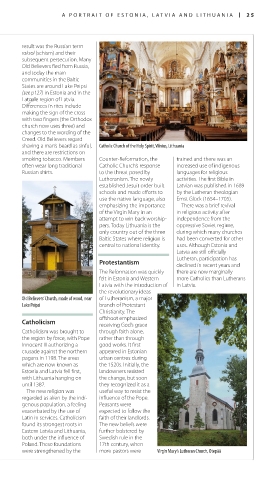
       shaving a man’s beard as sinful,   Catholic Church of the Holy Spirit, Vilnius, Lithuania
       and there are restrictions on
       smoking tobacco. Members   Counter-Reformation, the   trained and there was an
       often wear long traditional   Catholic Church’s response    increased use of indigenous
       Russian shirts.     to the threat posed by   languages for religious
                           Lutheranism. The newly   activities. The first Bible in
                           established Jesuit order built   Latvian was pub lished in 1689
                           schools and made efforts to   by the Lutheran theologian
                           use the native language, also   Ernst Glück (1654–1705).
                           emphasizing the importance     There was a brief revival
                           of the Virgin Mary in an   in religious activity after
                           attempt to win back worship-  inde pendence from the
                           pers. Today Lithuania is the   oppres sive Soviet regime,
                           only country out of the three   during which many churches
                           Baltic States where religion is   had been converted for other
                           central to national identity.  uses. Although Estonia and
                                              Latvia are still officially
                                              Lutheran, partici pation has
                           Protestantism
                                              declined in recent years and
                           The Reformation was quickly   there are now marginally
                           felt in Estonia and Western   more Catholics than Lutherans
                           Latvia with the introduction of   in Latvia.
                           the revolutionary ideas
       Old Believers’ Church, made of wood, near   of Lutheranism, a major
       Lake Peipsi         branch of Protestant
                           Christianity. The
                           offshoot empha sized
       Catholicism
                           receiving God’s grace
       Catholicism was brought to   through faith alone,
       the region by force, with Pope   rather than through
       Innocent III authorizing a   good works. It first
       crusade against the north ern   appeared in Estonian
       pagans in 1198. The areas   urban centres during
       which are now known as   the 1520s. Initially, the
       Estonia and Latvia fell first,    landowners resisted
       with Lithuania hanging on   the change, but soon
       until 1387.         they recognized it as a
         The new religion was   useful way to resist the
       regarded as alien by the indi-  influence of the Pope.
       genous population, a feeling   Peasants were
       exacerbated by the use of    expected to follow the
       Latin in services. Catholicism   faith of their landlords.
       found its strongest roots in   The new beliefs were
       Eastern Latvia and Lithuania,   further bolstered by
       both under the influence of   Swedish rule in the
       Poland. These foundations   17th century, when
       were strengthened by the   more pastors were   Virgin Mary’s Lutheran Church, Otepää

