


Page 24 - (DK Eyewitness) Travel Guide - Estonia Latvia & Lithuania
P. 24
22       INTRODUCING  EST ONIA ,  LA T VIA  AND  LITHU ANIA


        Landscape and Wildlife
        The three Baltic countries are heavily forested with
        pine, spruce and birch and enjoy a predominantly flat
        terrain, although there are hilly areas such as the
        Vidzeme Upland in Latvia. The highest point in the
        region is Estonia’s Suur Munamägi peak, which rises to
        about 318 m (1,043 ft) above sea level. The Baltic States
        are known for their dramatic coastlines, innumerable
        lakes and rivers as well as extensive wetlands which,
        along with forests, provide habitats for a wide range of
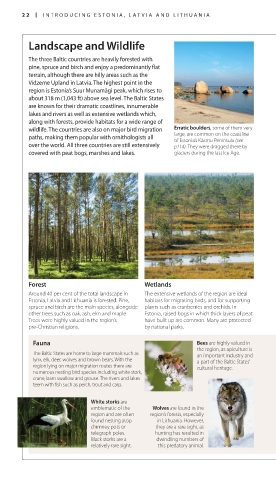
        wildlife. The countries are also on major bird migration   Erratic boulders, some of them very
                                              large, are common on the coastline
        paths, making them popular with ornitho logists all
                                              of Estonia’s Käsmu Peninsula (see
        over the world. All three countries are still extensively   p114). They were dragged there by
        covered with peat bogs, marshes and lakes.  glaciers during the last Ice Age.


        Forest                        Wetlands
        Around 40 per cent of the total landscape in   The extensive wetlands of the region are ideal
        Estonia, Latvia and Lithuania is forested. Pine,   habitats for migrating birds, and for supporting
        spruce and birch are the main species, alongside  plants such as cranberries and orchids. In
        other trees such as oak, ash, elm and maple.   Estonia, raised bogs in which thick layers of peat
        Trees were highly valued in the region’s    have built up are common. Many are protected
        pre-Christian religions.      by national parks.
          Fauna                                     Bees are highly valued in
                                                    the region, as apiculture is
          The Baltic States are home to large mammals such as   an important industry and
          lynx, elk, deer, wolves and brown bears. With the   a part of the Baltic States’
          region lying on major migra tion routes there are   cultural heritage.
          numerous nesting bird species including white stork,
          crane, barn swallow and grouse. The rivers and lakes
          teem with fish such as perch, trout and carp.
                        White storks are
                        emblematic of the   Wolves are found in the
                        region and are often   region’s forests, especially
                        found nesting atop   in Lithuania. However,
                        chimney pots or   they are a rare sight, as
                        telegraph poles.   hunting has resulted in
                        Black storks are a   dwindling numbers of
                        relatively rare sight.  this predatory animal.

