


Page 44 - (DK Eyewitness) Travel Guide - Estonia Latvia & Lithuania
P. 44
42       INTRODUCING  EST ONIA ,  LA T VIA  AND  LITHU ANIA


                                     to some extent by seizing Memel (Klaipėda)
                                     in 1923 from French troops.
                                       For the next 20 years, the three countries
                                     operated in a very similar manner. Weak,
                                     ever-changing govern ments in the 1920s
                                     gave way in the 1930s to strong statesmen
                                     who ran the state on Mussolini’s corporatist
                                     model. Even though nobody in any Baltic
                                     government had held a senior position
                                     before independence, it was remarkable
                                     what they were able to achieve in such a
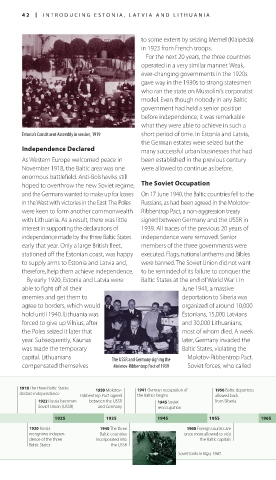
       Estonia’s Constituent Assembly in session, 1919  short period of time. In Estonia and Latvia,
                                     the German estates were seized but the
       Independence Declared         many suc cessful urban businesses that had
       As Western Europe welcomed peace in   been established in the previous century
       November 1918, the Baltic area was one   were allowed to continue as before.
       enormous battlefield. Anti-Bolsheviks still
       hoped to overthrow the new Soviet regime,   The Soviet Occupation
       and the Germans wanted to make up for losses  On 17 June 1940, the Baltic countries fell to the
       in the West with victories in the East. The Poles   Russians, as had been agreed in the Molotov-
       were keen to form another commonwealth   Ribbentrop Pact, a non-aggression treaty
       with Lithuania. As a result, there was little   signed between Germany and the USSR in
       interest in supporting the declarations of   1939. All traces of the previous 20 years of
       independence made by the three Baltic States   independence were removed. Senior
       early that year. Only a large British fleet,   members of the three governments were
       stationed off the Estonian coast, was happy  executed. Flags, national anthems and Bibles
       to supply arms to Estonia and Latvia and,   were banned. The Soviet Union did not want
       therefore, help them achieve independence.  to be reminded of its failure to conquer the
         By early 1920, Estonia and Latvia were   Baltic States at the end of World War I. In
       able to fight off all their              June 1941, a massive
       ene mies and get them to                 depor tation to Siberia was
       agree to borders, which would            organized of around 10,000
       hold until 1940. Lithuania was           Estonians, 15,000 Latvians
       forced to give up Vilnius, after         and 30,000 Lithuanians,
       the Poles seized it later that           most of whom died. A week
       year. Subsequently, Kaunas               later, Germany invaded the
       was made the temporary                   Baltic States, violating the
       capital. Lithuanians                      Molotov-Ribbentrop Pact.
                              The USSR and Germany signing the
       compensated themselves   Molotov-Ribbentrop Pact of 1939  Soviet forces, who called

      1918 The three Baltic States   1939 Molotov-  1941 German occupation of   1956 Baltic deportees
      declare independence
                      Ribbentrop Pact signed   the Baltics begins  allowed back
           1922 Russia becomes   between the USSR     1945 Soviet   from Siberia
           Soviet Union (USSR)  and Germany  reoccupation
               1925         1935         1945          1955         1965
         1920 Russia       1940 The three        1960 Foreign tourists are
         recognizes inde pen-  Baltic countries   once more allowed to visit
         dence of the three   incorporated into     the Baltic capitals
         Baltic States        the USSR
                                               Soviet tanks in Rīga, 1940

