


Page 42 - (DK Eyewitness) Travel Guide - Estonia Latvia & Lithuania
P. 42
40       INTRODUCING  EST ONIA ,  LA T VIA  AND  LITHU ANIA


       Jewish History
       The history of Jewish settlement in the Baltic region
       began in the 14th century, when Grand Duke Gediminas
       invited merchants and craftsmen into the Grand Duchy of
       Lithuania. Estonia only ever had a small Jewish population,
       while Jews arrived in Latvia in the 15th century, but were
       only allowed to settle in Rīga much later. During World War
       II, almost all Jews who did not flee were killed. Although
       some returned, the Jewish communities today are
       dwindling, partly due to emigration to Israel.
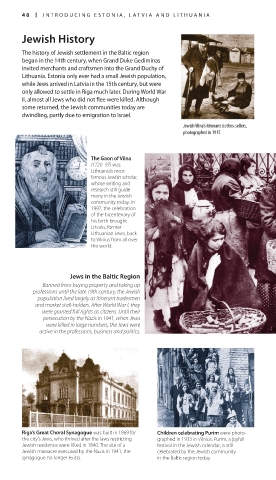
                                                Jewish Vilna’s itinerant clothes-sellers,
                                                photographed in 1915


                        The Gaon of Vilna
                        (1720–97) was
                        Lithuania’s most
                        famous Jewish scho lar,
                        whose writing and
                        research still guide
                        many in the Jewish
                        community today. In
                        1997, the celebration
                        of the bicentenary of
                        his birth brought
                        Litvaks, former
                        Lithuanian Jews, back
                        to Vilnius from all over
                        the world.


                   Jews in the Baltic Region
            Banned from buying property and taking up
         professions until the late 19th century, the Jewish
           population lived largely as itinerant tradesmen
          and market stall-holders. After World War I, they
            were granted full rights as citizens. Until their
            persecution by the Nazis in 1941, when Jews
             were killed in large numbers, the Jews were
           active in the professions, business and politics.


       Rīga’s Great Choral Synagogue was built in 1869 for   Children celebrating Purim were photo-
       the city’s Jews, who thrived after the laws restrict ing   graphed in 1933 in Vilnius. Purim, a joyful
       Jewish residence were lifted in 1840. The site of a   festival in the Jewish calendar, is still
       Jewish massacre executed by the Nazis in 1941, the   celebrated by the Jewish commu nity
       synagogue no longer exists.       in the Baltic region today.

