


Page 41 - (DK Eyewitness) Travel Guide - Estonia Latvia & Lithuania
P. 41
THE  HIST OR Y  OF  EST ONIA ,  LA T VIA  AND  LITHU ANIA       39


       were equally active in Latvia and Estonia.    War Returns
       In 1869, the first Estonian Song Festival was   Strikes and demonstrations took place in
       held, and in the following year, the writer   1905 in many cities throughout Russia, to
       Lydia Koidula produced her first play in   pressurize the Tsarist regime to grant civil
       Estonian, having previously only written in   rights and improve social conditions. Given
       German. It is significant that both events   the size of its industrial workforce at this
       took place in Tartu and not in Tallinn, where  time, Rīga was an active parti cipant in this
       German and Russian influence was still   unrest. In the country side, the protests
       too strong. The Latvian writer    were directed against the German
       Krišjānis Valdemārs also caused a   landed gentry and manor houses all
       stir in Tartu by printing his name-  over the region were attacked.
       card in Latvian. It was not until   These were social rather than
       1900, however, that Estonians,      nationalistic movements, partly as
       Latvians and Lithuanians could      the Balts were now able to use their
       freely proclaim their nation alities   own languages openly and could
       in their capital cities.            also take part in local administration.
                               Latvian writer Krišjānis
         In the 19th century, as in the   Valdemārs (1825–91)  National aspirations were, however,
       18th, the Russians delegated        forcibly dampened at the outbreak
       local admin istration to the Germans. It was,   of World War I (1914–18). The Russian
       there fore, the Germans, and not the   Revolution of 1917, which resulted in the
       Russians, who gained from the com mercial   collapse of Tsarist Russia and brought the
       potential of mass production, railways and   Bolsheviks to power, played a significant
       steamships. Rīga and Tallinn expanded   role in changing the course of the region’s
       hugely as ports and manufacturing centres.  history. The Civil War that followed soon
       The pros pect of work drew many people   after was seen as an opportunity for the
       from rural areas into the larger towns.  Baltic States to take control of their destiny.


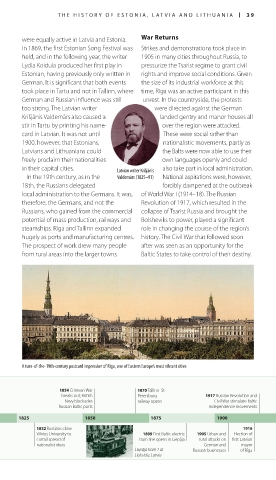
       A turn-of-the-19th-century postcard impression of Rīga, one of Eastern Europe’s most vibrant cities


                1854 Crimean War    1870 Tallinn–St
                 breaks out; British   Petersburg     1917 Russian Revolution and
                  Navy blockades    railway opens       Civil War stimulate Baltic
                Russian Baltic ports                   independence movements
      1825             1850             1875             1900
          1832 Russians close                                  1916
          Vilnius University to       1899 First Baltic electric   1905 Urban and   Election of
          curtail spread of          tram line opens in Liepāja  rural attacks on   first Latvian
          nationalist ideas                          German and   mayor
                                    Liepāja tram 1 at    Russian businesses  of Rīga
                                    Liela iela, Latvia

