


Page 39 - (DK Eyewitness) Travel Guide - Estonia Latvia & Lithuania
P. 39
THE  HIST OR Y  OF  EST ONIA ,  LA T VIA  AND  LITHU ANIA       37


                                     lived colonies in Africa and the Caribbean.
                                     The Swedish occupation, regarded as the
                                     gentlest Livonia ever endured, was marked by
                                     a benign governance. The Germans, mean-
                                     while, continued to hold sway in Livonia,
                                     socially and culturally. When an alterna tive to
                                     Latin was needed in the churches, German
                                     was the obvi ous choice. The universities at
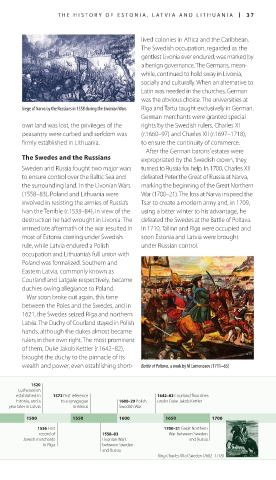
       Siege of Narva by the Russians in 1558 during the Livonian Wars  Rīga and Tartu taught exclusively in German.
                                     German merchants were granted special
       own land was lost, the privileges of the   rights by the Swedish rulers, Charles XI
       pea santry were curbed and serfdom was   (r.1660–97) and Charles XII (r.1697–1718),
       firmly established in Lithuania.  to ensure the continuity of commerce.
                                       After the German barons’ estates were
       The Swedes and the Russians   expropriated by the Swedish crown, they
       Sweden and Russia fought two major wars   turned to Russia for help. In 1700, Charles XII
       to ensure control over the Baltic Sea and   defeated Peter the Great of Russia at Narva,
       the surrounding land. In the Livonian Wars   marking the beginning of the Great Northern
       (1558–83), Poland and Lithuania were   War (1700–21). The loss at Narva inspired the
       involved in resisting the armies of Russia’s   Tsar to create a modern army and, in 1709,
       Ivan the Terrible (r.1533–84), in view of the   using a bitter winter to his advantage, he
       destruction he had wrought in Livonia. The   defeated the Swedes at the Battle of Poltava.
       immediate aftermath of the war resulted in   In 1710, Tallinn and Rīga were occupied and
       most of Estonia coming under Swedish   soon Estonia and Latvia were brought
       rule, while Latvia endured a Polish   under Russian control.
       occupation and Lithuania’s full union with
       Poland was formalized. Southern and
       Eastern Latvia, commonly known as
       Courland and Latgale respectively, became
       duchies owing allegiance to Poland.
         War soon broke out again, this time
       between the Poles and the Swedes, and in
       1621, the Swedes seized Rīga and northern
       Latvia. The Duchy of Courland stayed in Polish
       hands, although the dukes almost became
       rulers in their own right. The most prominent
       of them, Duke Jakob Kettler (r.1642–82),
       brought the duchy to the pinnacle of its
       wealth and power, even establishing short-  Battle of Poltava, a work by M Lomonosov (1711–65)

         1520
      Lutheranism
     established in   1572 First reference   1642–82 Courland flourishes
     Estonia, and a   to a synagogue    1600–29 Polish-  under Duke Jakob Kettler
   year later in Latvia  in Vilnius  Swedish War
        1500        1550        1600        1650       1700
           1536 First                      1700–21 Great Northern
           record of       1558–83          War between Sweden
       Jewish merchants    Livonian Wars          and Russia
            in Rīga        between Sweden
                           and Russia
                                          King Charles XII of Sweden (1682–1718)

