


Page 40 - (DK Eyewitness) Travel Guide - Estonia Latvia & Lithuania
P. 40
38       INTRODUCING  EST ONIA ,  LA T VIA  AND  LITHU ANIA


                                      Army marched through Vilnius en route to
                                      Moscow, and was greeted by the people
                                      as libe rators. In the same year Napoleon
                                      returned there, retreating ignominiously,
                                      not because the Russians had fought him
                                      success fully, but because they denied him
                                      supplies. In a pre-emptive move, the
                                      Russians burned down the wooden
                                      suburbs of Rīga to give them a clear firing
                                      line for defending the town. Eventually,
                                      the French army was forced to retreat.
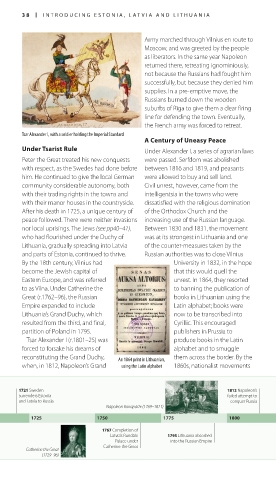
       Tsar Alexander I, with a soldier holding the Imperial Standard
                                      A Century of Uneasy Peace
       Under Tsarist Rule             Under Alexander I, a series of agrarian laws
       Peter the Great treated his new conquests   were passed. Serfdom was abo lished
       with respect, as the Swedes had done before  between 1816 and 1819, and peasants
       him. He continued to give the local German   were allowed to buy and sell land.
       community considerable autonomy, both   Civil unrest, however, came from the
       with their trading rights in the towns and   intelligentsia in the towns who were
       with their manor houses in the countryside.   dissatis fied with the religious domination
       After his death in 1725, a unique century of   of the Orthodox Church and the
       peace followed. There were neither invasions  increasing use of the Russian language.
       nor local uprisings. The Jews (see pp40–41),   Between 1830 and 1831, the movement
       who had flourished under the Duchy of   was at its strongest in Lithuania and one
       Lithuania, gradually sprea ding into Latvia   of the counter-measures taken by the
       and parts of Estonia, continued to thrive.    Russian authorities was to close Vilnius
       By the 18th century, Vilnius had       University in 1832, in the hope
       become the Jewish capital of           that this would quell the
       Eastern Europe, and was referred       unrest. In 1864, they resorted
       to as Vilna. Under Catherine the       to banning the publication of
       Great (r.1762–96), the Russian         books in Lithuanian using the
       Empire expanded to include             Latin alphabet; books were
       Lithuania’s Grand Duchy, which         now to be transcribed into
       resulted from the third, and final,    Cyrillic. This encouraged
       partition of Poland in 1795.           publishers in Prussia to
         Tsar Alexander I (r.1801–25) was     produce books in the Latin
       forced to forsake his dreams of        alphabet and to smuggle
       reconstituting the Grand Duchy,        them across the border. By the
                               An 1864 print in Lithuanian,
       when, in 1812, Napoleon’s Grand   using the Latin alphabet  1860s, nationalist movements

      1721 Sweden                                          1812 Napoleon’s
      surrenders Estonia                                   failed attempt to
      and Latvia to Russia                                  conquer Russia
                            Napoleon Bonaparte (1769–1821)
         1725             1750             1775             1800
                           1767 Completion of
                             Latvia’s Rundāle   1795 Lithuania absorbed
                               Palace under   into the Russian Empire
                            Catherine the Great
        Catherine the Great
            (1729–96)

