


Page 68 - Aviation News (February 2020)
P. 68
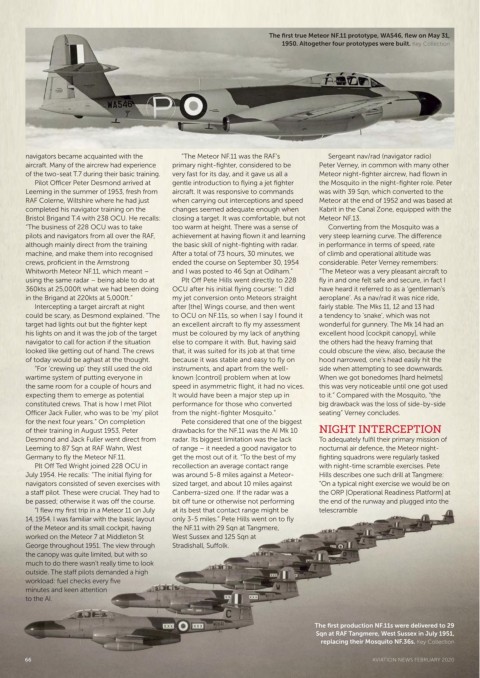
The first true Meteor NF.11 prototype, WA546, flew on May 31,
                                                                           1950. Altogether four prototypes were built. Key Collection


           navigators became acquainted with the   “The Meteor NF.11 was the RAF’s     Sergeant nav/rad (navigator radio)
           aircraft. Many of the aircrew had experience   primary night-fighter, considered to be   Peter Verney, in common with many other
           of the two-seat T.7 during their basic training.   very fast for its day, and it gave us all a   Meteor night-fighter aircrew, had flown in
              Pilot Officer Peter Desmond arrived at   gentle introduction to flying a jet fighter   the Mosquito in the night-fighter role. Peter
           Leeming in the summer of 1953, fresh from   aircraft. It was responsive to commands   was with 39 Sqn, which converted to the
           RAF Colerne, Wiltshire where he had just   when carrying out interceptions and speed   Meteor at the end of 1952 and was based at
           completed his navigator training on the   changes seemed adequate enough when   Kabrit in the Canal Zone, equipped with the
           Bristol Brigand T.4 with 238 OCU. He recalls:   closing a target. It was comfortable, but not   Meteor NF.13.
           “The business of 228 OCU was to take   too warm at height. There was a sense of   Converting from the Mosquito was a
           pilots and navigators from all over the RAF,   achievement at having flown it and learning   very steep learning curve. The difference
           although mainly direct from the training   the basic skill of night-fighting with radar.   in performance in terms of speed, rate
           machine, and make them into recognised   After a total of 73 hours, 30 minutes, we   of climb and operational altitude was
           crews, proficient in the Armstrong   ended the course on September 30, 1954   considerable. Peter Verney remembers:
           Whitworth Meteor NF.11, which meant –   and I was posted to 46 Sqn at Odiham.”  “The Meteor was a very pleasant aircraft to
           using the same radar – being able to do at   Plt Off Pete Hills went directly to 228   fly in and one felt safe and secure, in fact I
           360kts at 25,000ft what we had been doing   OCU after his initial flying course: “I did   have heard it referred to as a ‘gentleman’s
           in the Brigand at 220kts at 5,000ft.”   my jet conversion onto Meteors straight   aeroplane’. As a nav/rad it was nice ride,
              Intercepting a target aircraft at night   after [the] Wings course, and then went   fairly stable. The Mks 11, 12 and 13 had
           could be scary, as Desmond explained. “The   to OCU on NF.11s, so when I say I found it   a tendency to ‘snake’, which was not
           target had lights out but the fighter kept   an excellent aircraft to fly my assessment   wonderful for gunnery. The Mk 14 had an
           his lights on and it was the job of the target   must be coloured by my lack of anything   excellent hood [cockpit canopy], while
           navigator to call for action if the situation   else to compare it with. But, having said   the others had the heavy framing that
           looked like getting out of hand. The crews   that, it was suited for its job at that time   could obscure the view, also, because the
           of today would be aghast at the thought.   because it was stable and easy to fly on   hood narrowed, one’s head easily hit the
              “For ‘crewing up’ they still used the old   instruments, and apart from the well-  side when attempting to see downwards.
           wartime system of putting everyone in   known [control] problem when at low   When we got bonedomes [hard helmets]
           the same room for a couple of hours and   speed in asymmetric flight, it had no vices.   this was very noticeable until one got used
           expecting them to emerge as potential   It would have been a major step up in   to it.” Compared with the Mosquito, “the
           constituted crews. That is how I met Pilot   performance for those who converted   big drawback was the loss of side-by-side
           Officer Jack Fuller, who was to be ‘my’ pilot   from the night-fighter Mosquito.”  seating” Verney concludes.
           for the next four years.” On completion   Pete considered that one of the biggest
           of their training in August 1953, Peter   drawbacks for the NF.11 was the AI Mk 10   NIGHT INTERCEPTION
           Desmond and Jack Fuller went direct from   radar. Its biggest limitation was the lack   To adequately fulfil their primary mission of
           Leeming to 87 Sqn at RAF Wahn, West   of range – it needed a good navigator to   nocturnal air defence, the Meteor night-
           Germany to fly the Meteor NF.11.     get the most out of it. “To the best of my   fighting squadrons were regularly tasked
              Plt Off Ted Wright joined 228 OCU in   recollection an average contact range   with night-time scramble exercises. Pete
           July 1954. He recalls: “The initial flying for   was around 5-8 miles against a Meteor-  Hills describes one such drill at Tangmere:
           navigators consisted of seven exercises with   sized target, and about 10 miles against   “On a typical night exercise we would be on
           a staff pilot. These were crucial. They had to   Canberra-sized one. If the radar was a   the ORP [Operational Readiness Platform] at
           be passed; otherwise it was off the course.   bit off tune or otherwise not performing   the end of the runway and plugged into the
              “I flew my first trip in a Meteor 11 on July   at its best that contact range might be   telescramble
           14, 1954. I was familiar with the basic layout   only 3-5 miles.” Pete Hills went on to fly
           of the Meteor and its small cockpit, having   the NF.11 with 29 Sqn at Tangmere,
           worked on the Meteor 7 at Middleton St   West Sussex and 125 Sqn at
           George throughout 1951. The view through   Stradishall, Suffolk.
           the canopy was quite limited, but with so
           much to do there wasn’t really time to look
           outside. The staff pilots demanded a high
           workload: fuel checks every five
           minutes and keen attention
           to the AI.


                                                                                   The first production NF.11s were delivered to 29
                                                                                    Sqn at RAF Tangmere, West Sussex in July 1951,
                                                                                     replacing their Mosquito NF.36s. Key Collection

           66                                                                                     AVIATION NEWS FEBRUARY 2020


       64-69_meteorsDC.mfDC.mfDC.indd   66                                                                       10/01/2020   14:39

