


Page 67 - Aviation News (February 2020)
P. 67
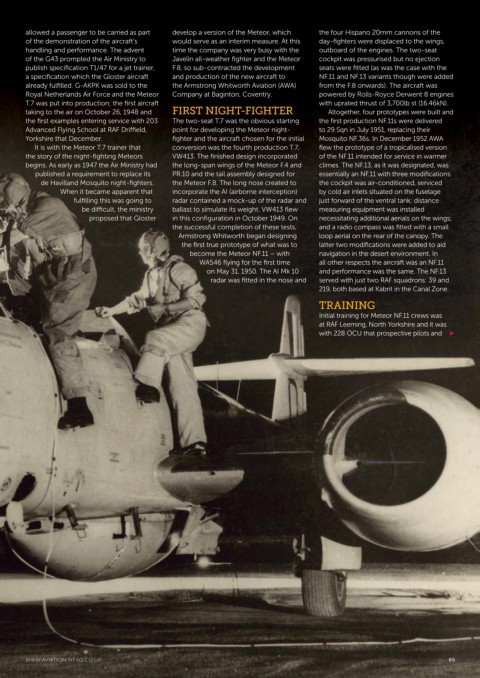
allowed a passenger to be carried as part   develop a version of the Meteor, which   the four Hispano 20mm cannons of the
           of the demonstration of the aircraft’s   would serve as an interim measure. At this   day-fi ghters were displaced to the wings,
           handling and performance. The advent   time the company was very busy with the   outboard of the engines. The two-seat
           of the G43 prompted the Air Ministry to   Javelin all-weather fi ghter and the Meteor   cockpit was pressurised but no ejection
           publish specifi cation T1/47 for a jet trainer,   F.8, so sub-contracted the development   seats were fi tted (as was the case with the
           a specifi cation which the Gloster aircraft   and production of the new aircraft to   NF.11 and NF.13 variants though were added
           already fulfi lled. G-AKPK was sold to the   the Armstrong Whitworth Aviation (AWA)   from the F.8 onwards). The aircraft was
           Royal Netherlands Air Force and the Meteor   Company at Baginton, Coventry.   powered by Rolls-Royce Derwent 8 engines
           T.7 was put into production; the fi rst aircraft                          with uprated thrust of 3,700lb st (16.46kN).
           taking to the air on October 26, 1948 and   FIRST NIGHT-FIGHTER             Altogether, four prototypes were built and
           the fi rst examples entering service with 203   The two-seat T.7 was the obvious starting   the fi rst production NF.11s were delivered
           Advanced Flying School at RAF Dri   eld,   point for developing the Meteor night-  to 29 Sqn in July 1951, replacing their
           Yorkshire that December.             fi ghter and the aircraft chosen for the initial   Mosquito NF.36s. In December 1952 AWA
              It is with the Meteor T.7 trainer that   conversion was the fourth production T.7,   fl ew the prototype of a tropicalised version
           the story of the night-fi ghting Meteors   VW413. The fi nished design incorporated   of the NF.11 intended for service in warmer
           begins. As early as 1947 the Air Ministry had   the long-span wings of the Meteor F.4 and   climes. The NF.13, as it was designated, was
              published a requirement to replace its   PR.10 and the tail assembly designed for   essentially an NF.11 with three modifi cations:
               de Havilland Mosquito night-fi ghters.   the Meteor F.8. The long nose created to   the cockpit was air-conditioned, serviced
                    When it became apparent that   incorporate the AI (airborne interception)   by cold air inlets situated on the fuselage
                       fulfi lling this was going to   radar contained a mock-up of the radar and   just forward of the ventral tank; distance
                         be di   cult, the ministry   ballast to simulate its weight. VW413 fl ew   measuring equipment was installed
                           proposed that Gloster   in this confi guration in October 1949. On   necessitating additional aerials on the wings;
                                                the successful completion of these tests,   and a radio compass was fi tted with a small
                                                 Armstrong Whitworth began designing   loop aerial on the rear of the canopy. The
                                                  the fi rst true prototype of what was to   latter two modifi cations were added to aid
                                                    become the Meteor NF.11 – with   navigation in the desert environment. In
                                                       WA546 fl ying for the fi rst time   all other respects the aircraft was an NF.11
                                                        on May 31, 1950. The AI Mk 10   and performance was the same. The NF.13
                                                         radar was fi tted in the nose and   served with just two RAF squadrons: 39 and
                                                                                    219, both based at Kabrit in the Canal Zone.
                                                                                    TRAINING
                                                                                    Initial training for Meteor NF.11 crews was
                                                                                    at RAF Leeming, North Yorkshire and it was
                                                                                    with 228 OCU that prospective pilots and


           WWW.AVIATION NEWS.CO.UK                                                                                   65


       64-69_meteorsDC.mfDC.mfDC.indd   65                                                                       10/01/2020   14:39

