


Page 69 - Aviation News (February 2020)
P. 69
[a special phone attached to each aircraft]
           on two minutes’ readiness with, as far as
           possible, all cockpit checks completed. The
           first indication of likely activity would come
           with a click in the earphones as the sector
           controller opened his line to our station
           ops room. Sector ops would then issue
           instructions along the lines of: ‘Tangmere,
           scramble two aircraft, vector 180, angels 30,
           call X [the GCI call sign] on XXXX [frequency].
              “Tangmere ops had the list of those on
           the ORP and the order they were in, so they
           would pass on the instructions to the first
           two aircraft on the order list. We knew who
           was next, so as immediately sector had
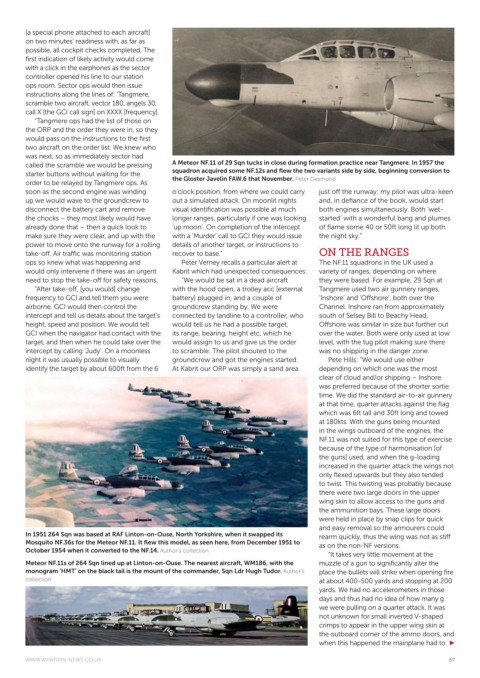
           called the scramble we would be pressing   A Meteor NF.11 of 29 Sqn tucks in close during formation practice near Tangmere. In 1957 the
           starter buttons without waiting for the   squadron acquired some NF.12s and flew the two variants side by side, beginning conversion to
           order to be relayed by Tangmere ops. As   the Gloster Javelin FAW.6 that November. Peter Desmond
           soon as the second engine was winding   o’clock position, from where we could carry   just off the runway; my pilot was ultra-keen
           up we would wave to the groundcrew to   out a simulated attack. On moonlit nights   and, in defiance of the book, would start
           disconnect the battery cart and remove   visual identification was possible at much   both engines simultaneously. Both ‘wet-
           the chocks – they most likely would have   longer ranges, particularly if one was looking   started’ with a wonderful bang and plumes
           already done that – then a quick look to   ‘up moon’. On completion of the intercept   of flame some 40 or 50ft long lit up both
           make sure they were clear, and up with the   with a ‘Murder’ call to GCI they would issue   the night sky.”
           power to move onto the runway for a rolling   details of another target, or instructions to
           take-off. Air traffic was monitoring station   recover to base.”         ON THE RANGES
           ops so knew what was happening and     Peter Verney recalls a particular alert at   The NF.11 squadrons in the UK used a
           would only intervene if there was an urgent   Kabrit which had unexpected consequences:  variety of ranges, depending on where
           need to stop the take-off for safety reasons.  “We would be sat in a dead aircraft   they were based. For example, 29 Sqn at
              “After take-off, [you would] change   with the hood open, a trolley acc [external   Tangmere used two air gunnery ranges,
           frequency to GCI and tell them you were   battery] plugged in, and a couple of   ‘Inshore’ and ‘Offshore’, both over the
           airborne. GCI would then control the   groundcrew standing by. We were   Channel. Inshore ran from approximately
           intercept and tell us details about the target’s   connected by landline to a controller, who   south of Selsey Bill to Beachy Head,
           height, speed and position. We would tell   would tell us he had a possible target,   Offshore was similar in size but further out
           GCI when the navigator had contact with the   its range, bearing, height etc, which he   over the water. Both were only used at low
           target, and then when he could take over the   would assign to us and give us the order   level, with the tug pilot making sure there
           intercept by calling ‘Judy’. On a moonless   to scramble. The pilot shouted to the   was no shipping in the danger zone.
           night it was usually possible to visually   groundcrew and got the engines started.   Pete Hills: “We would use either
           identify the target by about 600ft from the 6   At Kabrit our ORP was simply a sand area   depending on which one was the most
                                                                                    clear of cloud and/or shipping – Inshore
                                                                                    was preferred because of the shorter sortie
                                                                                    time. We did the standard air-to-air gunnery
                                                                                    at that time, quarter attacks against the flag
                                                                                    which was 6ft tall and 30ft long and towed
                                                                                    at 180kts. With the guns being mounted
                                                                                    in the wings outboard of the engines, the
                                                                                    NF.11 was not suited for this type of exercise
                                                                                    because of the type of harmonisation [of
                                                                                    the guns] used, and when the g-loading
                                                                                    increased in the quarter attack the wings not
                                                                                    only flexed upwards but they also tended
                                                                                    to twist. This twisting was probably because
                                                                                    there were two large doors in the upper
                                                                                    wing skin to allow access to the guns and
                                                                                    the ammunition bays. These large doors
                                                                                    were held in place by snap clips for quick
                                                                                    and easy removal so the armourers could
           In 1951 264 Sqn was based at RAF Linton-on-Ouse, North Yorkshire, when it swapped its   rearm quickly, thus the wing was not as stiff
           Mosquito NF.36s for the Meteor NF.11. It flew this model, as seen here, from December 1951 to   as on the non-NF versions.
           October 1954 when it converted to the NF.14. Author’s collection
                                                                                       “It takes very little movement at the
           Meteor NF.11s of 264 Sqn lined up at Linton-on-Ouse. The nearest aircraft, WM186, with the   muzzle of a gun to significantly alter the
           monogram ‘HMT’ on the black tail is the mount of the commander, Sqn Ldr Hugh Tudor. Author’s   place the bullets will strike when opening fire
           collection                                                               at about 400-500 yards and stopping at 200
                                                                                    yards. We had no accelerometers in those
                                                                                    days and thus had no idea of how many g
                                                                                    we were pulling on a quarter attack. It was
                                                                                    not unknown for small inverted V-shaped
                                                                                    crimps to appear in the upper wing skin at
                                                                                    the outboard corner of the ammo doors, and
                                                                                    when this happened the mainplane had to

           WWW.AVIATION-NEWS.CO.UK                                                                                   67


       64-69_meteorsDC.mfDC.mfDC.indd   67                                                                       10/01/2020   14:40

