


Page 70 - Aviation News (February 2020)
P. 70
by NATO. It was designed to test the latest
                                                                                    concepts in dispersal, tactical air control
                                                                                    and execution of alert plans in the event
                                                                                    of an atomic war. For the purposes of this
                                                                                    exercise the US 12th Air Force and the 4th
                                                                                    Allied Tactical Air Force (ATAF) of NATO were
                                                                                    pitted against the forces of the 2nd ATAF.
                                                                                       The action commenced on June 20
                                                                                    and Peter Desmond took part: “We were
                                                                                    detached to Brustem in Belgium for two
                                                                                    weeks under canvas for the exercise.
                                                                                    We flew mostly at night, and Jack and
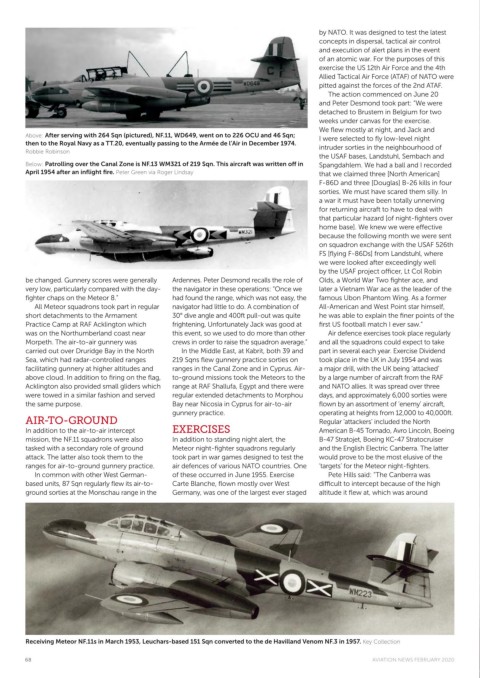
           Above: After serving with 264 Sqn (pictured), NF.11, WD649, went on to 226 OCU and 46 Sqn;   I were selected to fly low-level night
           then to the Royal Navy as a TT.20, eventually passing to the Armée de l’Air in December 1974.   intruder sorties in the neighbourhood of
           Robbie Robinson
                                                                                    the USAF bases, Landstuhl, Sembach and
           Below: Patrolling over the Canal Zone is NF.13 WM321 of 219 Sqn. This aircraft was written off in   Spangdahlem. We had a ball and I recorded
           April 1954 after an inflight fire. Peter Green via Roger Lindsay         that we claimed three [North American]
                                                                                    F-86D and three [Douglas] B-26 kills in four
                                                                                    sorties. We must have scared them silly. In
                                                                                    a war it must have been totally unnerving
                                                                                    for returning aircraft to have to deal with
                                                                                    that particular hazard [of night-fighters over
                                                                                    home base]. We knew we were effective
                                                                                    because the following month we were sent
                                                                                    on squadron exchange with the USAF 526th
                                                                                    FS [flying F-86Ds] from Landstuhl, where
                                                                                    we were looked after exceedingly well
                                                                                    by the USAF project officer, Lt Col Robin
           be changed. Gunnery scores were generally   Ardennes. Peter Desmond recalls the role of   Olds, a World War Two fighter ace, and
           very low, particularly compared with the day-  the navigator in these operations: “Once we   later a Vietnam War ace as the leader of the
           fighter chaps on the Meteor 8.”      had found the range, which was not easy, the   famous Ubon Phantom Wing. As a former
              All Meteor squadrons took part in regular   navigator had little to do. A combination of   All-American and West Point star himself,
           short detachments to the Armament    30° dive angle and 400ft pull-out was quite   he was able to explain the finer points of the
           Practice Camp at RAF Acklington which   frightening, Unfortunately Jack was good at   first US football match I ever saw.”
           was on the Northumberland coast near   this event, so we used to do more than other   Air defence exercises took place regularly
           Morpeth. The air-to-air gunnery was   crews in order to raise the squadron average.”   and all the squadrons could expect to take
           carried out over Druridge Bay in the North   In the Middle East, at Kabrit, both 39 and   part in several each year. Exercise Dividend
           Sea, which had radar-controlled ranges   219 Sqns flew gunnery practice sorties on   took place in the UK in July 1954 and was
           facilitating gunnery at higher altitudes and   ranges in the Canal Zone and in Cyprus. Air-  a major drill, with the UK being ‘attacked’
           above cloud. In addition to firing on the flag,   to-ground missions took the Meteors to the   by a large number of aircraft from the RAF
           Acklington also provided small gliders which   range at RAF Shallufa, Egypt and there were   and NATO allies. It was spread over three
           were towed in a similar fashion and served   regular extended detachments to Morphou   days, and approximately 6,000 sorties were
           the same purpose.                    Bay near Nicosia in Cyprus for air-to-air   flown by an assortment of ‘enemy’ aircraft,
                                                gunnery practice.                   operating at heights from 12,000 to 40,000ft.
           AIR-TO-GROUND                                                            Regular ‘attackers’ included the North
           In addition to the air-to-air intercept   EXERCISES                      American B-45 Tornado, Avro Lincoln, Boeing
           mission, the NF.11 squadrons were also   In addition to standing night alert, the   B-47 Stratojet, Boeing KC-47 Stratocruiser
           tasked with a secondary role of ground   Meteor night-fighter squadrons regularly   and the English Electric Canberra. The latter
           attack. The latter also took them to the   took part in war games designed to test the   would prove to be the most elusive of the
           ranges for air-to-ground gunnery practice.   air defences of various NATO countries. One   ‘targets’ for the Meteor night-fighters.
              In common with other West German-  of these occurred in June 1955. Exercise   Pete Hills said: “The Canberra was
           based units, 87 Sqn regularly flew its air-to-  Carte Blanche, flown mostly over West   difficult to intercept because of the high
           ground sorties at the Monschau range in the   Germany, was one of the largest ever staged   altitude it flew at, which was around


           Receiving Meteor NF.11s in March 1953, Leuchars-based 151 Sqn converted to the de Havilland Venom NF.3 in 1957. Key Collection

           68                                                                                     AVIATION NEWS FEBRUARY 2020


       64-69_meteorsDC.mfDC.mfDC.indd   68                                                                       10/01/2020   14:40

