


Page 71 - Aviation News (February 2020)
P. 71
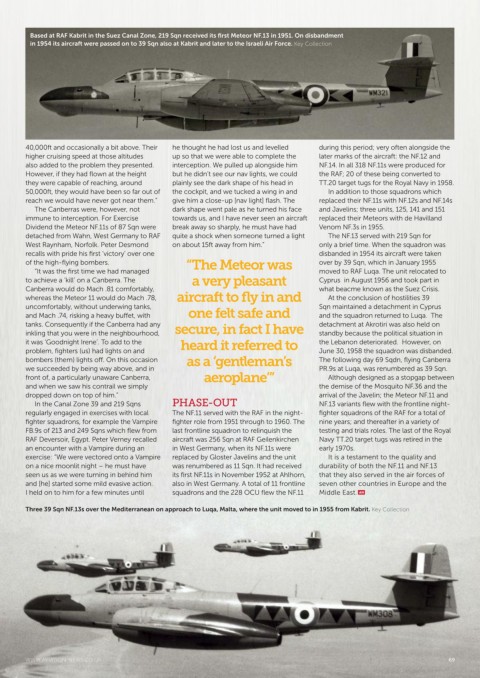
Based at RAF Kabrit in the Suez Canal Zone, 219 Sqn received its fi rst Meteor NF.13 in 1951. On disbandment
             in 1954 its aircraft were passed on to 39 Sqn also at Kabrit and later to the Israeli Air Force. Key Collection


           40,000ft and occasionally a bit above. Their   he thought he had lost us and levelled   during this period; very often alongside the
           higher cruising speed at those altitudes   up so that we were able to complete the   later marks of the aircraft: the NF.12 and
           also added to the problem they presented.   interception. We pulled up alongside him   NF.14. In all 318 NF.11s were produced for
           However, if they had fl own at the height   but he didn’t see our nav lights, we could   the RAF; 20 of these being converted to
           they were capable of reaching, around   plainly see the dark shape of his head in   TT.20 target tugs for the Royal Navy in 1958.
           50,000ft, they would have been so far out of   the cockpit, and we tucked a wing in and   In addition to those squadrons which
           reach we would have never got near them.”  give him a close-up [nav light] fl ash. The   replaced their NF.11s with NF.12s and NF.14s
              The Canberras were, however, not   dark shape went pale as he turned his face   and Javelins; three units, 125, 141 and 151
           immune to interception. For Exercise   towards us, and I have never seen an aircraft   replaced their Meteors with de Havilland
           Dividend the Meteor NF.11s of 87 Sqn were   break away so sharply, he must have had   Venom NF.3s in 1955.
           detached from Wahn, West Germany to RAF   quite a shock when someone turned a light   The NF.13 served with 219 Sqn for
           West Raynham, Norfolk. Peter Desmond   on about 15ft away from him.”     only a brief time. When the squadron was
           recalls with pride his fi rst ‘victory’ over one                          disbanded in 1954 its aircraft were taken
           of the high-fl ying bombers.             “The Meteor was                  over by 39 Sqn, which in January 1955
              “It was the fi rst time we had managed                                 moved to RAF Luqa. The unit relocated to
           to achieve a ‘kill’ on a Canberra. The    a very pleasant                Cyprus  in August 1956 and took part in
           Canberra would do Mach .81 comfortably,                                  what beacme known as the Suez Crisis.
           whereas the Meteor 11 would do Mach .78,   aircraft to fl y in and           At the conclusion of hostilities 39
           uncomfortably, without underwing tanks,                                  Sqn maintained a detachment in Cyprus
           and Mach .74, risking a heavy bu  et, with   one felt safe and           and the squadron returned to Luqa.  The
           tanks. Consequently if the Canberra had any                              detachment at Akrotiri was also held on
           inkling that you were in the neighbourhood,  secure, in fact I have      standby because the political situation in
           it was ‘Goodnight Irene’. To add to the   heard it referred to           the Lebanon deteriorated.  However, on
           problem, fi ghters (us) had lights on and                                 June 30, 1958 the squadron was disbanded.
           bombers (them) lights o  . On this occasion   as a ‘gentleman’s          The following day 69 Sqdn, fl ying Canberra
           we succeeded by being way above, and in                                  PR.9s at Luqa, was renumbered as 39 Sqn.
           front of, a particularly unaware Canberra,   aeroplane’”                    Although designed as a stopgap between
           and when we saw his contrail we simply                                   the demise of the Mosquito NF.36 and the
           dropped down on top of him.”                                             arrival of the Javelin; the Meteor NF.11 and
              In the Canal Zone 39 and 219 Sqns   PHASE-OUT                         NF.13 variants fl ew with the frontline night-
           regularly engaged in exercises with local   The NF.11 served with the RAF in the night-  fi ghter squadrons of the RAF for a total of
           fi ghter squadrons, for example the Vampire   fi ghter role from 1951 through to 1960. The   nine years; and thereafter in a variety of
           FB.9s of 213 and 249 Sqns which fl ew from   last frontline squadron to relinquish the   testing and trials roles. The last of the Royal
           RAF Deversoir, Egypt. Peter Verney recalled   aircraft was 256 Sqn at RAF Geilenkirchen   Navy TT.20 target tugs was retired in the
           an encounter with a Vampire during an   in West Germany, when its NF.11s were   early 1970s.
           exercise: “We were vectored onto a Vampire   replaced by Gloster Javelins and the unit   It is a testament to the quality and
           on a nice moonlit night – he must have   was renumbered as 11 Sqn. It had received   durability of both the NF.11 and NF.13
           seen us as we were turning in behind him   its fi rst NF.11s in November 1952 at Ahlhorn,   that they also served in the air forces of
           and [he] started some mild evasive action.   also in West Germany. A total of 11 frontline   seven other countries in Europe and the
           I held on to him for a few minutes until   squadrons and the 228 OCU fl ew the NF.11   Middle East.

           Three 39 Sqn NF.13s over the Mediterranean on approach to Luqa, Malta, where the unit moved to in 1955 from Kabrit. Key Collection


           WWW.AVIATION NEWS.CO.UK                                                                                   69


       64-69_meteorsDC.mfDC.mfDC.indd   69                                                                       10/01/2020   14:40

