


Page 58 - All About History - Issue 08-14
P. 58
Hitler’s astronauts


        life, but also my first contact with the theoretical   applications of rockets. They had already set up a   applications and, following German military
        and practical aspects of rocketry and space travel.”  test facility just south of Berlin, in Kummersdorf,   expansion, the Nazis established a dedicated
          Oberth’s work had inspired countless rocket   under the direction of German artillery officer   centre of rocketry at Peenemünde where these
        enthusiasts in Germany, resulting in the formation   Walter Dornberger, and by 1934 von Braun was   technologies could be further researched and
        of several amateur rocketry societies. Perhaps the   actively working alongside Dornberger in the   developed. On 2 April 1936, the Reich Aviation
        most notable was Verein für Raumschiffahrt (VfR),   development of a liquid-fuelled rocket. Von Braun   Ministry had purchased the northern peninsula of
        or the ‘Society for Space Travel’ in English. The   was soon given his own team to lead and at the   Usedom, a Baltic island on the border of Germany
        association was established in 1927 and Oberth   end of 1934 they had launched two rockets, known   and Poland. Here, the village of Peenemünde
        and von Braun were early members. Beginning   as the A-2, with the latter reaching a new record   was transformed into an unprecedented research
        in 1930, the VfR requested funding from the   height of 3.5 kilometres (2.2 miles).
        German army for rocket experiments – military   By 1937 the facility was becoming too limited
        development in Germany was restricted by the   for the wildly ambitious tests planned by the
        Treaty of Versailles, but rocketry was not inhibited.   team of rocket scientists. One such project was
        Thus their request was granted, and in 1930 they   the development of a plane that was propelled
        successfully tested a more powerful version of   through rocket power alone, as opposed to a front-
        Oberth’s earlier rocket motor at an abandoned   facing propeller. Thus the team were moved to
        ammunition dump in Berlin. By 1932 they had   Neuhardenberg, an open area 110 kilometres (70
        developed and flown a rocket that could reach a   miles) east of Berlin. On 3 June 1937, they flew a
        height of over one kilometre (0.62 miles). When   modified Heinkel HE 112 plane that, for part of
        the army asked the group to sign a contract for a   its flight flown by test pilot Erich Warsitz, was
        demonstration launch, however, the group became   propelled solely by a rocket on the rear of the
        divided and was eventually dissolved in 1933.   plane. Although this particular concept was not
          By now the German army was becoming   advanced much further, it proved to Hitler and
                                 at Peenemünde”
        increasingly interested in the development and   the Nazi Party that rockets had useful practical
              “ The Nazis made the decision to create a
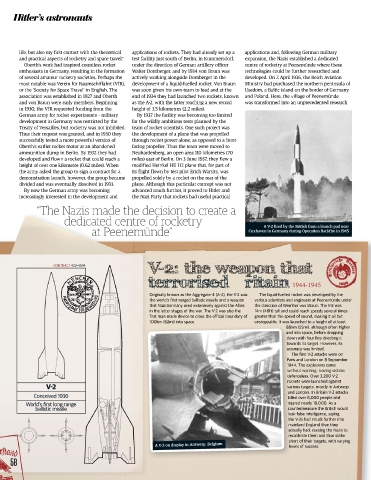
                        dedicated centre of rocketry                                    Cuxhaven in Germany during Operation Backfire in 1945
                                                                                              A V-2 fired by the British from a launch pad near


                                                     V-2: the weapon                                that
                    CONTRACT 422-4594
                                                     terrorised                    Britain 1944-1945


                                                      Originally known as the Aggregate-4 (A-4), the V-2 was   The liquid-fuelled rocket was developed by the
                                                      the world’s first ranged ballistic missile and a weapon   various scientists and engineers at Peenemünde under
                                                      that Nazi Germany used extensively against the Allies   the direction of Wernher von Braun. The V-2 was
                                                      in the latter stages of the war. The V-2 was also the   14m (46ft) tall and could reach speeds several times
                                                      first man-made device to cross the official boundary of   greater than the speed of sound, making it all but
                                                      100km (62mi) into space.            unstoppable. It was launched to a height of at least
                                                                                                      88km (55mi), although often higher
                                                                                                      and into space, before dropping
                                                                                                      down with four fins directing it
                                                                                                      towards its target. However, its
                                                                                                      accuracy was limited.
                                                                                                       The first V-2 attacks were on
                                                                                                      Paris and London on 8 September
                                                                                                      1944. The explosions came
                                                                                                      without warning, leaving victims
                                                                                                      defenceless. Over 3,200 V-2
                                                                                                      rockets were launched against
                 V-2                                                                                  various targets, mostly in Antwerp
                                                                                                      and London. In Britain V-2 attacks
             Conceived 1936                                                                           killed over 6,000 people and
          World’s first long-range                                                                    injured nearly 18,000. As a
             ballistic missile                                                                        countermeasure the British would
                                                                                                      leak false intelligence, saying
                                                                                                      the V-2s had struck further into
                                                                                                      mainland England than they
                                                                                                      actually had, causing the Nazis to
                                                                                                      recalibrate them and thus strike
                                                                                                       short of their targets, with varying
                                                        A V-2 on display in Antwerp, Belgium           levels of success.

     58

